
Attachments of the lesser and greater omentum
Read the draft explanation
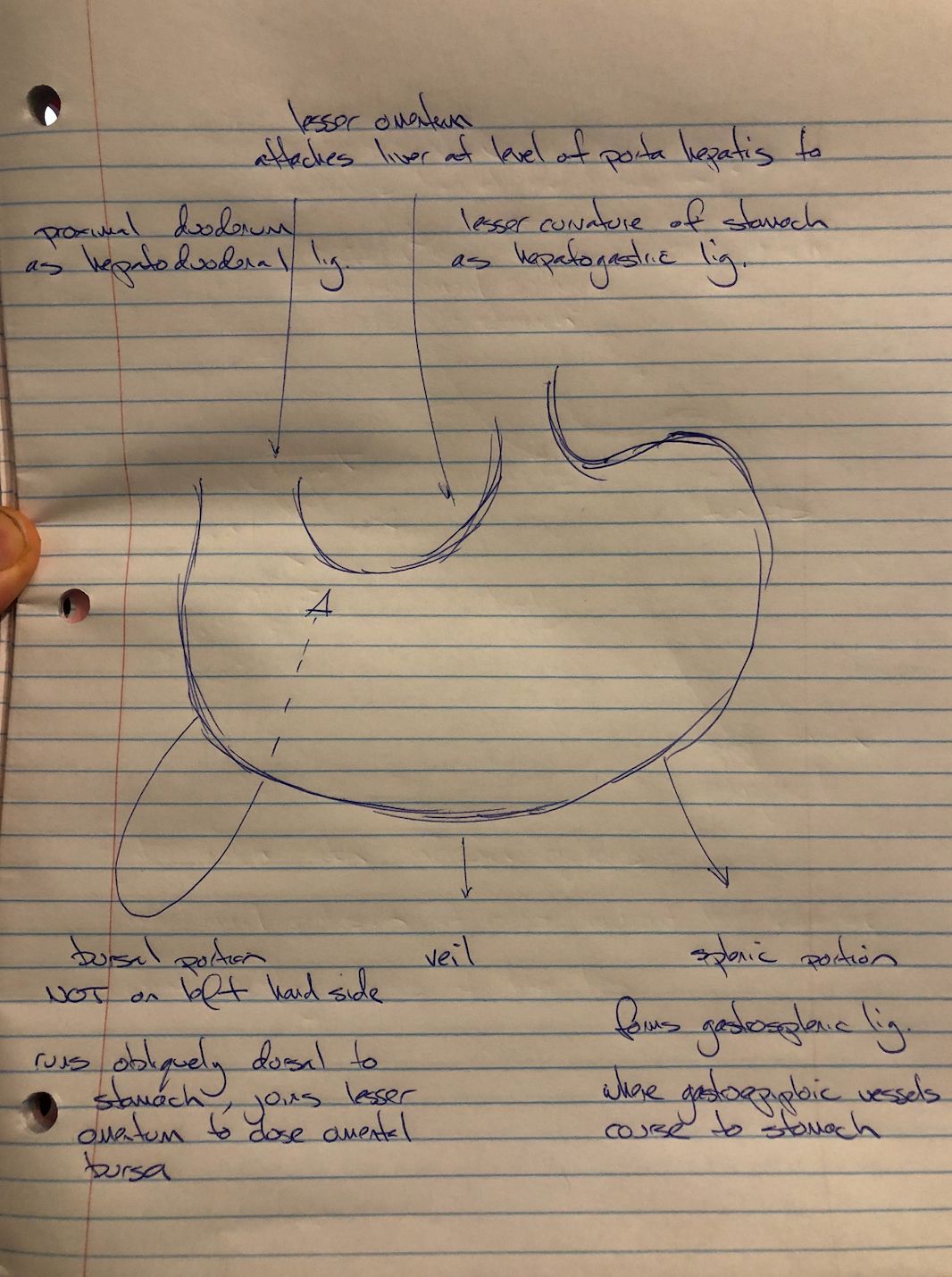
The lesser omentum links the porta hepatis to the stomach’s lesser curvature and the proximal duodenum. Its hepatogastric ligament runs from liver to stomach. Its hepatoduodenal ligament runs from liver to duodenum. These are connected parts of one fold of peritoneum.
The greater omentum has three portions: bursal, splenic and veil. The large bursal portion attaches along most of the greater curvature. The attachment takes a different route on the patient’s left side. It crosses obliquely over the dorsal stomach and joins the lesser omentum. This closes that border of the omental bursa.
The bursal portion folds back on itself. It has a superficial ventral leaf and a deep dorsal leaf. Each leaf is a double peritoneal sheet. The omental bursa is the potential space between them. The epiploic foramen remains its natural opening.
The splenic portion reaches the splenic hilus and forms the gastrosplenic ligament. Gastroepiploic vessels travel through this region to the stomach. The small veil portion contains the left lobe of the pancreas.
Use the stomach as the centre of the map. Follow the lesser curvature toward the liver, then the greater curvature toward the bursal and splenic portions. Keep the left dorsal attachment and the pancreatic veil as separate landmarks.
References
Johnston and Tobias, Veterinary Surgery: Small Animal, 2nd ed., Chapters 86 and 91, Figs. 86.4 and 91.2.