
Age of onset and glandular versus complex benign prostatic hyperplasia
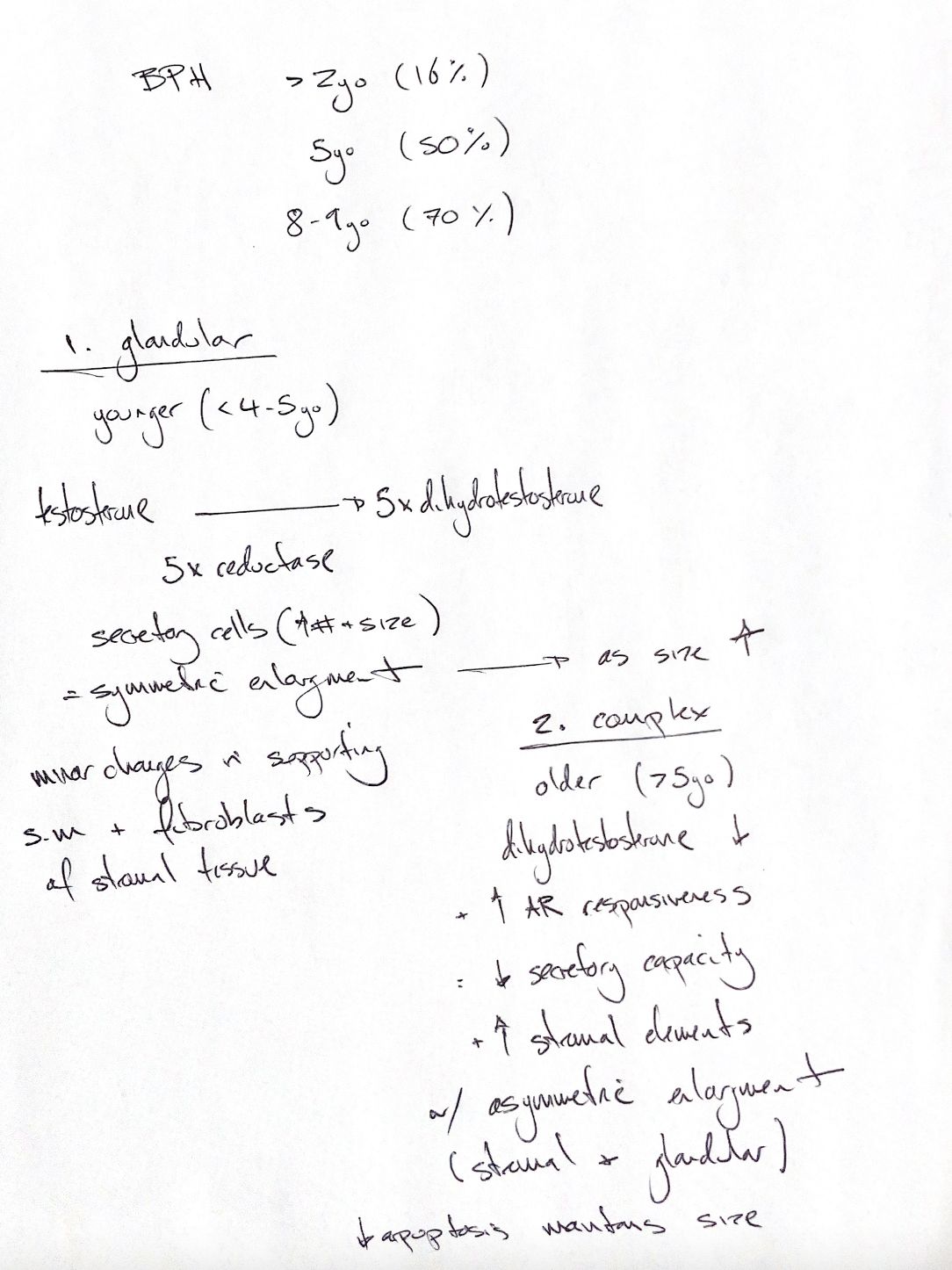
Read the draft explanation
BPH means benign prostatic hyperplasia. The source note lists 16% after 2 years, 50% at 5 years and 70% at 8–9 years. The book puts the first figure at up to 16% by about 2 years. Its cited study does not reproduce that series. Brendler and colleagues studied 42 untreated male Beagles at one point in time. Histologic BPH affected 2 of 5 dogs in the mean 2.4-year group, 6 of 6 at 7.2 years and 4 of 4 at 8.6 years. These small groups describe microscopic changes, not clinical disease prevalence in all dogs.
The glandular form predominates before about 4–5 years. In the prostate, 5α-reductase converts testosterone to 5α-dihydrotestosterone, or DHT. Secretory cells increase in number and size, so the gland enlarges symmetrically. The supporting stroma, made up of smooth muscle and fibroblasts, changes only a little.
As the gland grows, the complex form becomes more common after about 5 years. It contains both glandular tissue and more prominent stromal elements. Enlargement is asymmetric, and secretory capacity falls. The age ranges overlap; they are not strict diagnostic cutoffs.
The textbook describes falling tissue DHT with more nuclear androgen receptors and greater androgen responsiveness. Primary studies report differing DHT findings, so this is not a fixed hormone pattern in every dog. A lower rate of cell death, or apoptosis, may help maintain the enlarged gland. That is a proposed explanation, rather than proof that one mechanism accounts for every case.
References
Chris Wood’s drawing; Johnston & Tobias, Veterinary Surgery: Small Animal, 2nd ed., ch 113; Brendler et al. 1983, doi:10.1172/JCI110861 (full paper, Tables I–II); Ewing et al. 1983, PMID 6196180 and Isaacs 1983, PMID 6191128 (complete indexed abstracts).