
Urethral regions, muscles and spay-associated tissue changes
Read the draft explanation
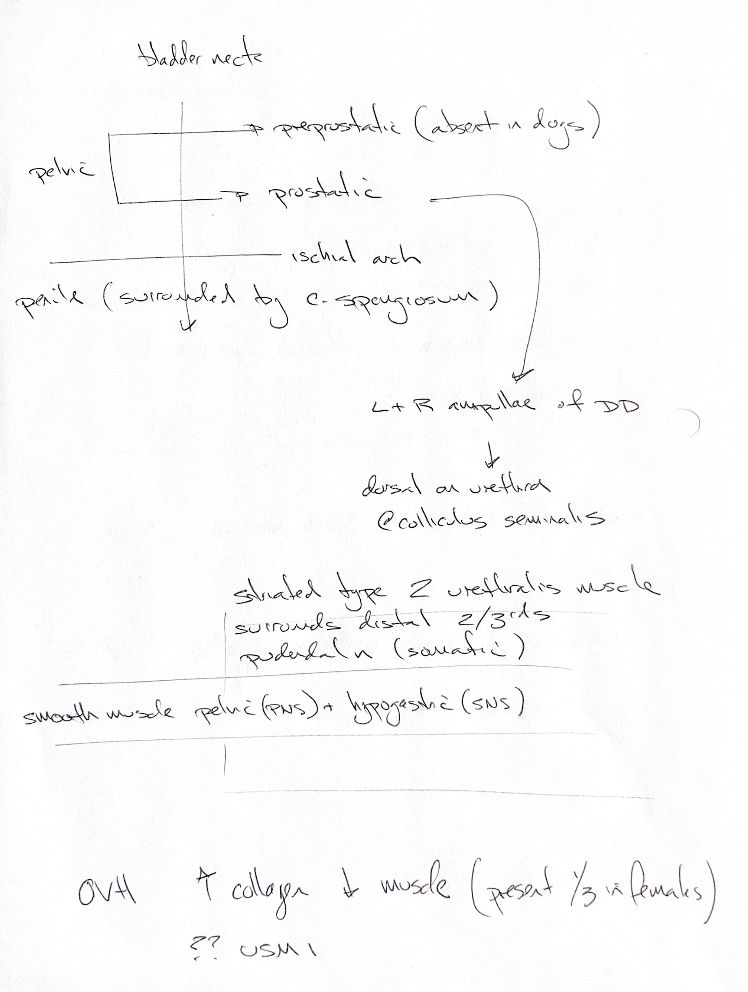
The male urethra has pelvic and penile parts. The preprostatic segment is essentially absent in dogs, while male cats have a distinct segment. The prostatic urethra runs through the prostate. The postprostatic pelvic segment continues to the ischial arch. From there, the penile urethra is surrounded by corpus spongiosum. The left and right deferent ducts open beside the dorsal colliculus seminalis.
Keep the muscle types and their nerves separate. Urethralis is striated muscle, supplied by the pudendal nerve. It is mainly type II, with some type I fibres and breed variation. The original and book say “distal two-thirds” in male dogs, but the exact region for that fraction remains unclear. Urethralis covers the postprostatic pelvic urethra. This does not establish a fraction of the whole male urethra. In female dogs, striated and smooth muscle interdigitate in the distal third. Female smooth muscle tapers toward the external opening. Urethral smooth muscle receives pelvic parasympathetic and hypogastric sympathetic input.
The spay cue refers to relative tissue composition. A 2008 study of 20 healthy dogs found more collagen and less muscle by proportion after gonadectomy. Sex and tissue region also mattered. An earlier small Beagle study found lower smooth-muscle and connective-tissue volumes, with significant relative changes only in the proximal quarter. Another small study found no change in collagen-type or actin staining. These are different measurements. Tissue findings may help explain post-neutering USMI, or urethral sphincter mechanism incompetence, but do not prove that every spayed dog becomes incontinent.
The postprostatic pelvic label completes a region omitted from the original shorthand and supplied paragraph.
References
Chris Wood’s ACVS notes; Johnston & Tobias, Veterinary Surgery: Small Animal, 2nd ed., ch.117–118; University of Minnesota canine anatomy; Ponglowhapan et al., Theriogenology 2008;70:1516–1524; Augsburger studies 1995 and 2007. Primary abstracts and supplied text checked; full articles not obtained.