
Bladder healing and the urethral seven-day cue
Read the draft explanation
The bladder repairs its lining quickly, but lining closure, tissue strength and collagen production are different milestones.
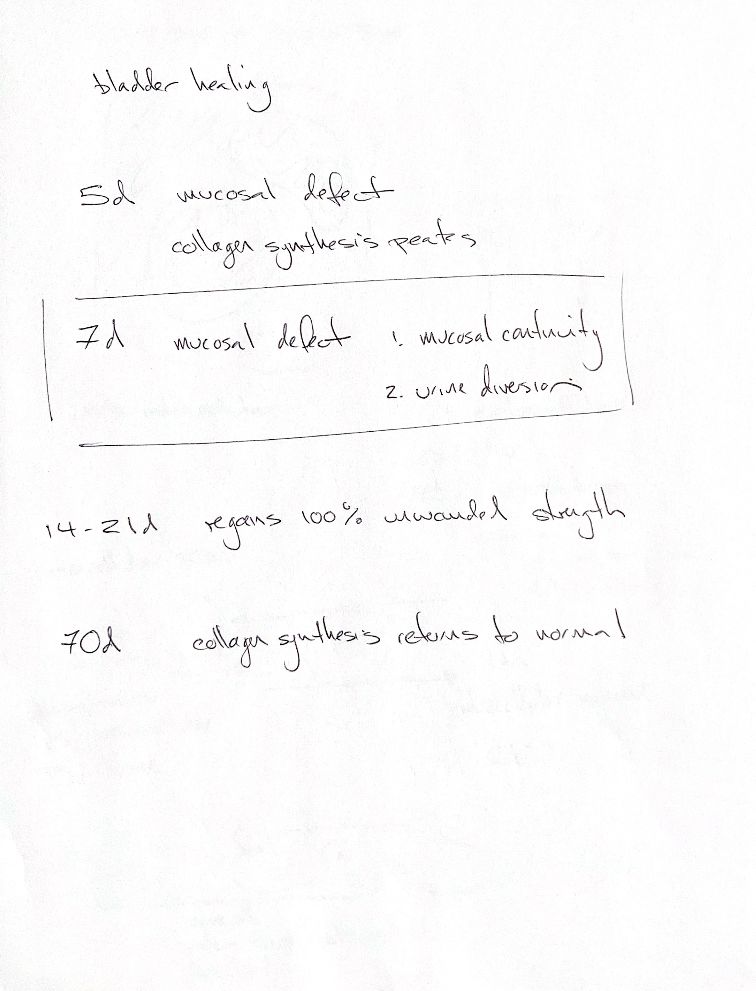
The original five-day cue has two parts. The supplied bladder chapter says mucosal defects can heal in five days. The cited experimental study also reports that collagen synthesis peaks at day five. Mucosa is the inner lining; collagen helps the wound regain strength.
The book gives 14–21 days for a full-thickness wound through all bladder layers to regain 100% of normal tissue strength. The primary abstract supports strength equal to unwounded bladder wall within 21 days. Equal strength does not mean identical tissue structure. Its collagen synthesis rate returns to the unwounded baseline by day 70. This describes a production rate, not collagen disappearing or the wound suddenly becoming strong at day 70. These are historical experimental benchmarks. Traumatized, inflamed or infected tissue may heal more slowly.
There is a separate urethral cue inside the original bladder note. The seven-day statement belongs to urethral mucosal regeneration. The book requires some mucosal continuity and diversion of urine away from the injury. It does not describe an unconditional seven-day bladder milestone. A completely transected urethra falls outside that statement. The seven days are a healing cue, not a fixed catheter-removal instruction.
References
Chris Wood’s ACVS note; Johnston & Tobias, Veterinary Surgery: Small Animal, 2nd ed., supplied PDF pp. 438, 5153 and 5192–5193; Hastings et al., Surg Gynecol Obstet 1975;140:933–937, PMID1129685. Primary abstract read; full article not obtained. The exact five-day mucosal and seven-day urethral statements retain textbook support.