
Ureter course, circumcaval variation and diameter cues
Read the draft explanation
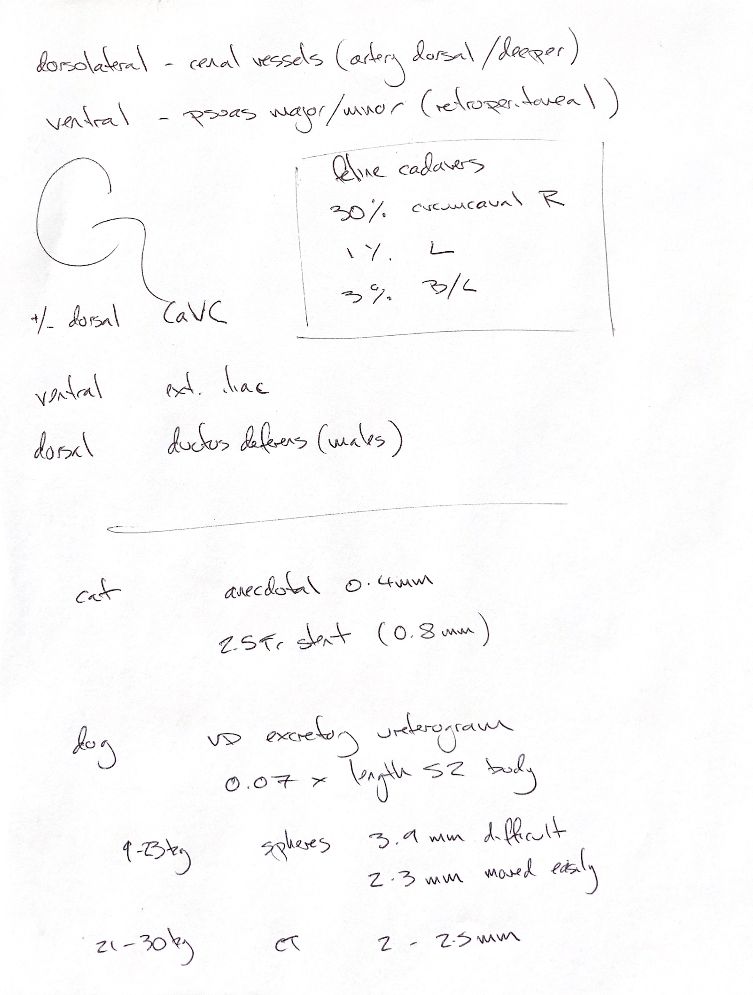
The ureters carry urine from the renal pelves to the bladder by peristalsis. At the hilum, the renal artery lies dorsal to the renal vein. The ureters leave dorsolateral to these vessels and run through the retroperitoneal space, ventral to psoas major and minor. They pass ventral to the external iliac vessels. In males, they pass dorsal to the ductus deferens before entering the bladder.
The right ureter normally lies just lateral to the caudal vena cava. A circumcaval ureter passes dorsal to the vena cava before returning toward its usual course. In one study of 301 feline shelter cadavers, 92 had a right circumcaval ureter, 4 a left and 10 bilateral: 30.6%, 1.3% and 3.3%. These match the original rounded 30%, 1% and 3% recall cues. The study’s clinical relevance was unknown; cadaver frequency does not prove obstruction risk.
Keep the measurement method with each diameter cue. The nonobstructed distal feline lumen is described anecdotally as about 0.4 mm. A 2.5-Fr stent is about 0.8 mm across. That device size is a different measurement from the native lumen and comes from treatment of obstructive ureterolithiasis.
For dogs, the historical ventrodorsal excretory-urogram guideline estimates the upper ureter’s luminal diameter as 0.07 times the length of the L2 vertebral body. It is not a fixed normal diameter for every dog.
The textbook also describes a steel-sphere experiment in dogs weighing 9–23 kg. Spheres 3.9 mm across were difficult to insert, while 2.3-mm spheres moved easily. That experiment does not define a safe stone-passage threshold or the resting lumen’s diameter.
In six healthy dogs weighing 21–30 kg, the textbook reports average CT ureter diameters of 2.0–2.5 mm before and after contrast. These historical study measurements depend on body size and method. They should not be substituted for one another or treated as a universal canine cutoff.
References
Johnston and Tobias, Veterinary Surgery: Small Animal, 2nd ed., Chapter 115; Bélanger et al. 2014; Feeney et al. 1979; Kim et al. 1970; Rozear and Tidwell 2003.