
TPLO complications - mechanics and TTA geometry
Read the draft explanation
TPLO rock-back, pivot shift and TTA answer three different questions about the canine stifle.
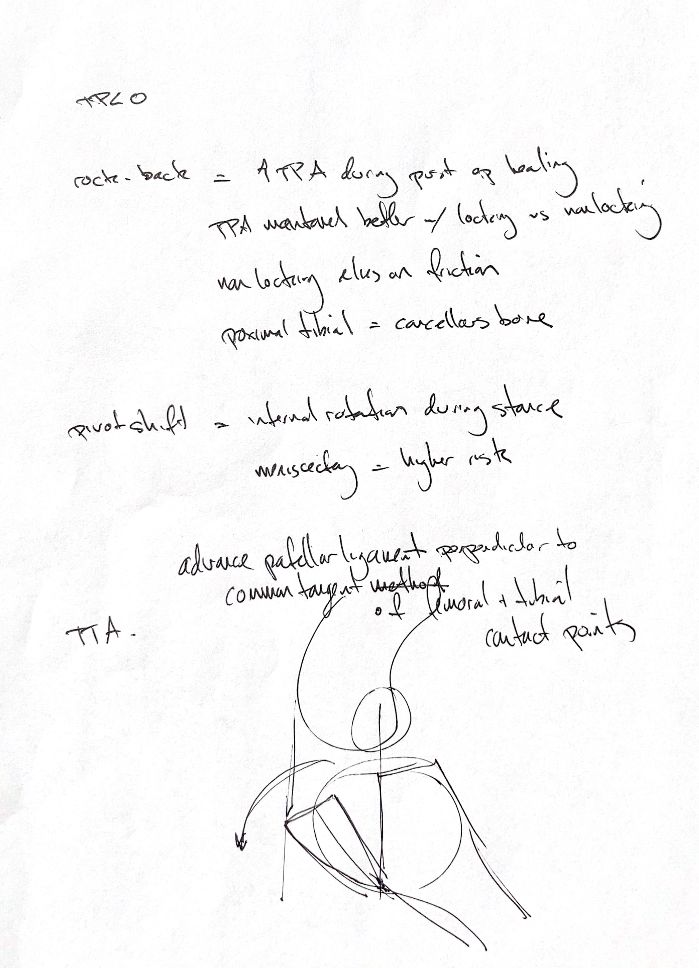
TPLO means tibial plateau leveling osteotomy. Rock-back means the tibial plateau angle, or TPA, changes as the bone cut heals. TPA measures plateau slope from a line perpendicular to the tibial axis. Movement at the cut can cause a secondary loss of reduction. Small changes do not necessarily mean clinical failure. Conventional screws press the plate against bone, so plate–bone friction matters. Locking screw heads engage the plate and form a fixed-angle connection. The proximal tibia has cancellous bone within a cortical shell. In a prospective comparison of dogs weighing at least 20 kg, locking screws better conserved TPA during healing.
Pivot shift is a gait change during stance, when the foot bears weight. The tibia rotates internally relative to the femur. The reported gait change also includes cranial tibial subluxation and a sudden lateral change in stifle direction. Medial meniscectomy means removing medial meniscal tissue. It was associated with higher pivot-shift risk in a retrospective TPLO study. That study does not prove cause, and the amount removed was not consistently recorded.
For TTA, advance the tibial tuberosity cranially. This moves the patellar ligament toward a right angle to the common tangent at the femoral and tibial contact. The tangent is a line touching the joint contours where they meet. The circles help find it. The planned patella stays in place while the tibial attachment moves. The 90° target aims to neutralize cranial tibial thrust, or forward shear, in a simplified model. It does not prove full stability. Joint position and anatomy affect planning, and a two-dimensional model cannot capture every rotational movement. “Patellar tendon angle” is the usual TTA term; the structure below the patella is the patellar ligament here.
References
Chris Wood’s note; Johnston & Tobias, Veterinary Surgery: Small Animal, 2nd ed., chs 41 and 61; Conkling et al. 2010, doi:10.1111/j.1532-950X.2010.00656.x; Gatineau et al. 2011, doi:10.3415/VCOT-10-07-0109.