
Chondroitin, glucosamine and essential fatty acids
Read the draft explanation
These agents have different evidence. Fish-oil diets have direct canine OA trial support.
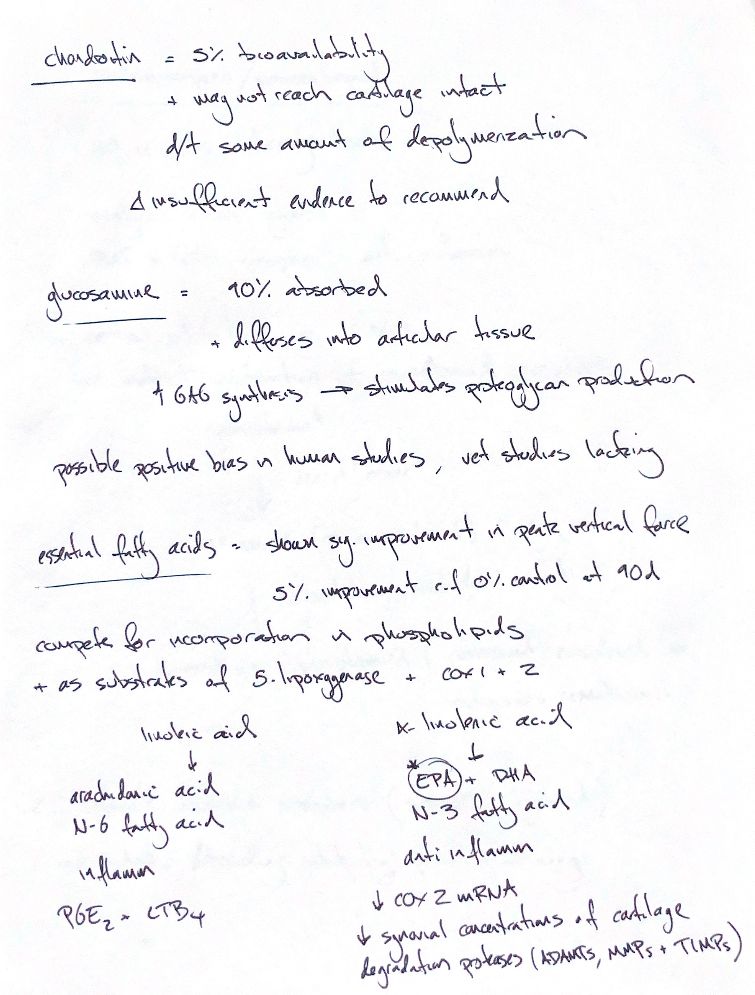
Chondroitin sulfate has about 5% oral bioavailability after a single dose in beagles, measured as total disaccharides. Depolymerization means it may not reach articular cartilage intact. Evidence is insufficient to recommend chondroitin alone for canine or feline OA.
The 90% glucosamine cue means gut absorption: that figure is reported in human glucosamine sulfate tracer work. Canine tracer work also found near-complete uptake of label. This differs from the roughly 12% systemic bioavailability of glucosamine HCl in beagles. Glucosamine distributes to articular tissues. In vitro, increased GAG synthesis may stimulate proteoglycan production, but culture results vary. Human OA trials raise concern about positive publication bias. Veterinary trials of glucosamine alone were lacking in the cited 2009 review.
The fatty-acid branches compete for membrane phospholipids and as substrates for COX-1, COX-2 and 5-lipoxygenase. Linoleic acid leads to arachidonic acid, an n-6 source of inflammatory PGE2 and LTB4. Alpha-linolenic acid leads toward n-3 EPA and DHA. In cartilage culture, n-3 fatty acids reduced COX-2 and ADAMTS/MMP mRNA; EPA was most active in the comparison.
A canine OA food trial found a 5.6% rise in mean peak vertical force by day 90 with the fish-oil test food, versus 0.4% with control. The change was significant within the test-food group. Other food ingredients also differed. In a separate CCL study, some proMMPs fell but TIMP-2 rose in the unoperated stifle. Measured markers did not change significantly in the operated stifle. TIMPs inhibit MMPs; they are not degrading proteases.
References
Johnston & Tobias, Veterinary Surgery: Small Animal, 2nd ed., ch. 68; Adebowale et al., Biopharm Drug Dispos 2002;23:217–225; Setnikar et al., Arzneimittelforschung 1993;43:1109–1113; Roush et al., JAVMA 2010;236:67–73; Hansen et al., J Nutr Biochem 2008;19:101–108; Hurst et al., Lipids 2009;44:889–896; Zainal et al., Osteoarthritis Cartilage 2009;17:896–905.