
Paracetamol central mechanisms
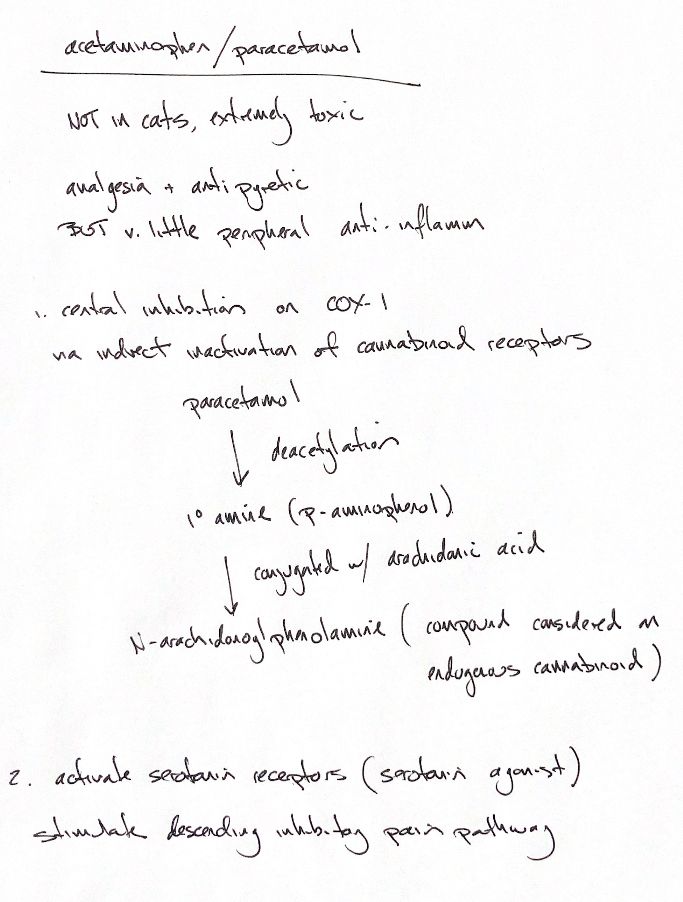
Read the draft explanation
Paracetamol and acetaminophen are the same drug. It provides analgesia and reduces fever, with little peripheral anti-inflammatory action. It is extremely toxic to cats and must not be used in this species.
Its central analgesic mechanism is not fully settled. One experimental pathway starts with deacetylation to the primary amine p-aminophenol. In the brain and spinal cord, FAAH-dependent conjugation with arachidonic acid forms N-arachidonoylphenolamine, or AM404.
AM404 is a drug-derived metabolite that modulates endocannabinoid signalling, including indirect CB₁ involvement. AM404 is drug-derived, which is distinct from the body's own endocannabinoids. Rodent and cell experiments support this pathway; they do not establish its full contribution to clinical analgesia in dogs.
A separate proposal involves central inhibition of a COX-1 splice variant. Acetaminophen inhibited the canine variant in an experimental system. This is a different mechanism cue from AM404-mediated cannabinoid signalling.
Paracetamol can also recruit descending serotonergic pain inhibition in rodent experiments. These pathways reduce nociceptive transmission in the spinal cord. This does not make paracetamol a proven direct serotonin-receptor agonist. A binding study instead supported an indirect serotonergic effect.
Keep these as proposed, interacting central mechanisms. Their relative contributions in dogs remain uncertain.
References
Johnston & Tobias, 2nd ed., Ch.68; Högestätt et al., 2005, PMID15987694; Chandrasekharan et al., 2002, PMID12242329; Raffa & Codd, 1996, PMID8699917; Dogrul et al., 2012, PMID22206817; FDA, Get the Facts about Pain Relievers for Pets.
https://pubmed.ncbi.nlm.nih.gov/15987694/
https://pubmed.ncbi.nlm.nih.gov/8699917/