
NSAID-specific profile reference
Read the draft explanation
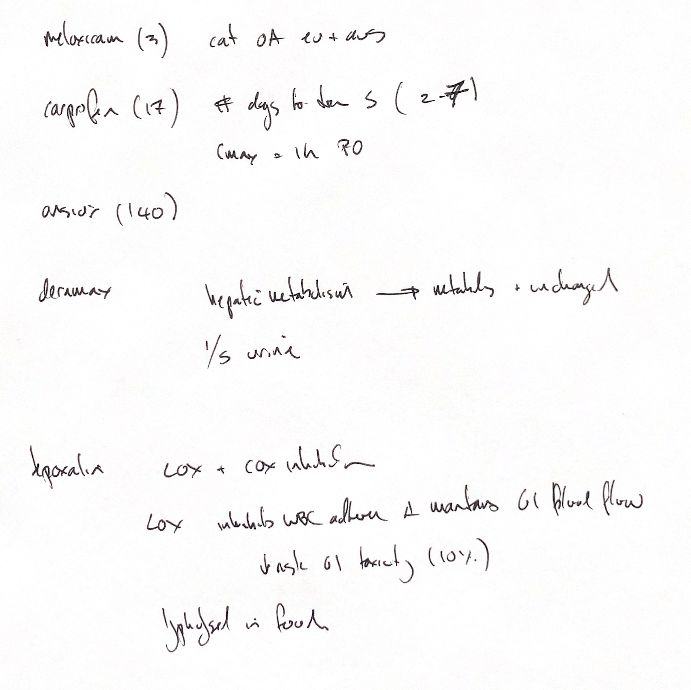
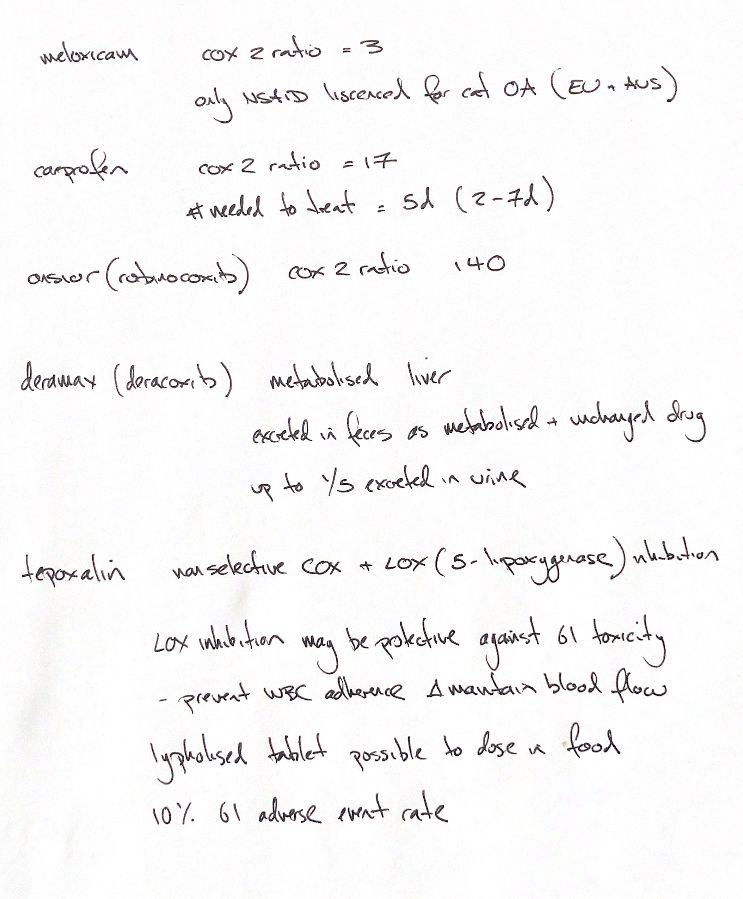
These COX ratios come from canine whole-blood assays. The IC50 is the concentration that inhibits half an enzyme’s activity. Using IC50(COX-1)/IC50(COX-2), the source values are about 3 for meloxicam, 17 for carprofen and 140 for robenacoxib, or Onsior. Different assays cannot rank clinical safety.
The historical meloxicam cue concerns long-term feline OA licensing in Europe and Australia; the book also lists New Zealand. Its “only NSAID” wording is outdated. Robenacoxib also has a chronic feline musculoskeletal indication in Europe, including the UK label. Licensing depends on country, formulation and indication.
For carprofen, 5 is a number of dogs, not treatment days. The textbook reports an NNT of 5 versus placebo, with a 95% confidence interval of 2–7, for a 14-day canine OA trial. It does not specify that estimate’s response endpoint. The original oral peak-concentration cue is about 1 hour; the product label gives 1–3 hours in dogs.
Deracoxib, or Deramaxx, undergoes mainly hepatic metabolism. Most leaves in feces as metabolites or unchanged drug. The book reports up to one-fifth in urine. The product label specifies that urine contains no unchanged parent drug.
Tepoxalin inhibits COX-1/2 and 5-lipoxygenase. Lower leukotriene activity may limit leukocyte adhesion and preserve mucosal blood flow. This is proposed GI protection. The historical lyophilised tablet could be placed in food. The note’s 10% GI-event cue is not a pooled risk: one historical 7-day field study reported vomiting or diarrhoea in 10/100 dogs. Rates varied, and haemorrhagic diarrhoea also occurred. Zubrin’s EU authorisation has been withdrawn.
References
Chris Wood’s notes; Johnston & Tobias, Veterinary Surgery: Small Animal, 2nd ed., ch.68, PDF2942,2945,2947–48; Streppa et al.2002; Innes et al.2010; FDA deracoxib/carprofen labels; UK Onsior SPC2023; EMA Zubrin assessment.