
NSAID mechanisms and joint tissue effects
Read the draft explanation
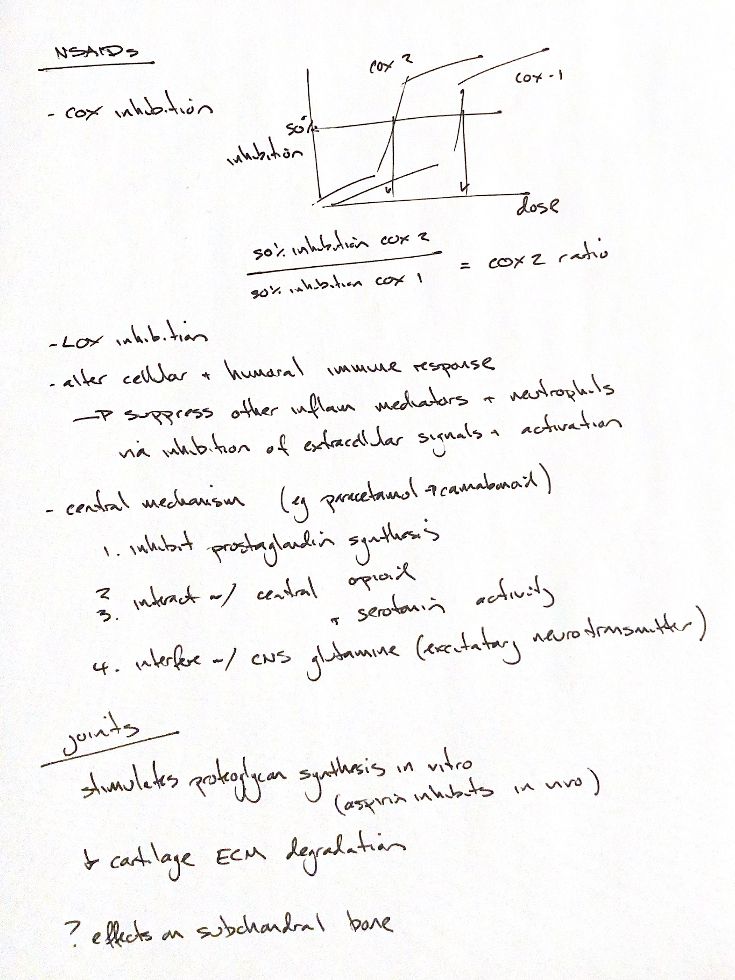
Nonsteroidal anti-inflammatory drugs (NSAIDs) reduce prostaglandin production by inhibiting cyclooxygenase (COX). The effect depends on the drug and concentration. IC₅₀ is the concentration that halves enzyme activity. In the sketch, COX-2 reaches 50% inhibition at a lower concentration than COX-1. The note uses IC₅₀(COX-2)/IC₅₀(COX-1), so COX-2 preference gives a ratio below one. The book uses the reciprocal ratio, which rises above one. Compare the same species and assay. Selectivity does not guarantee safety.
Some drugs also inhibit 5-lipoxygenase (5-LOX); tepoxalin is a dual COX/LOX example. Other effects can alter cellular and humoral immunity, dampen neutrophil activation and reduce release of inflammatory enzymes. Interference with extracellular signals varies by drug.
Proposed central contributions include reduced prostaglandin synthesis and interactions with opioid, serotonin and excitatory amino-acid signalling. The note and book say glutamine; glutamate is the excitatory transmitter, while glutamine is its precursor. These mechanisms are not established equally for every drug. Paracetamol is a related central analgesic with little peripheral anti-inflammatory activity. Rodent studies link its metabolite AM404 to TRPV1 channels and indirect cannabinoid pathways.
Joint-tissue findings also vary. Some NSAIDs stimulate proteoglycan synthesis in vitro, depending on concentration. Aspirin treatment in experimental dogs reduced synthesis measured later ex vivo. Some drugs reduce cartilage matrix breakdown in culture; tepoxalin reduced collagen loss in one canine explant model. These findings do not establish cartilage regeneration or clinical disease modification. Effects on subchondral bone remain an area of investigation.
References
Chris Wood's ACVS notes; Johnston & Tobias, Veterinary Surgery: Small Animal, 2nd ed., ch. 68, supplied PDF pp. 2941–2945. Palmoski & Brandt 1983, doi:10.1002/art.1780260808; Benton et al. 1997, doi:10.2460/ajvr.1997.58.03.286; Macrory et al. 2009, doi:10.1186/1746-6148-5-25. Barrière et al. 2020, doi:10.1111/bph.14934.