
Arachidonic acid pathway
Read the draft explanation
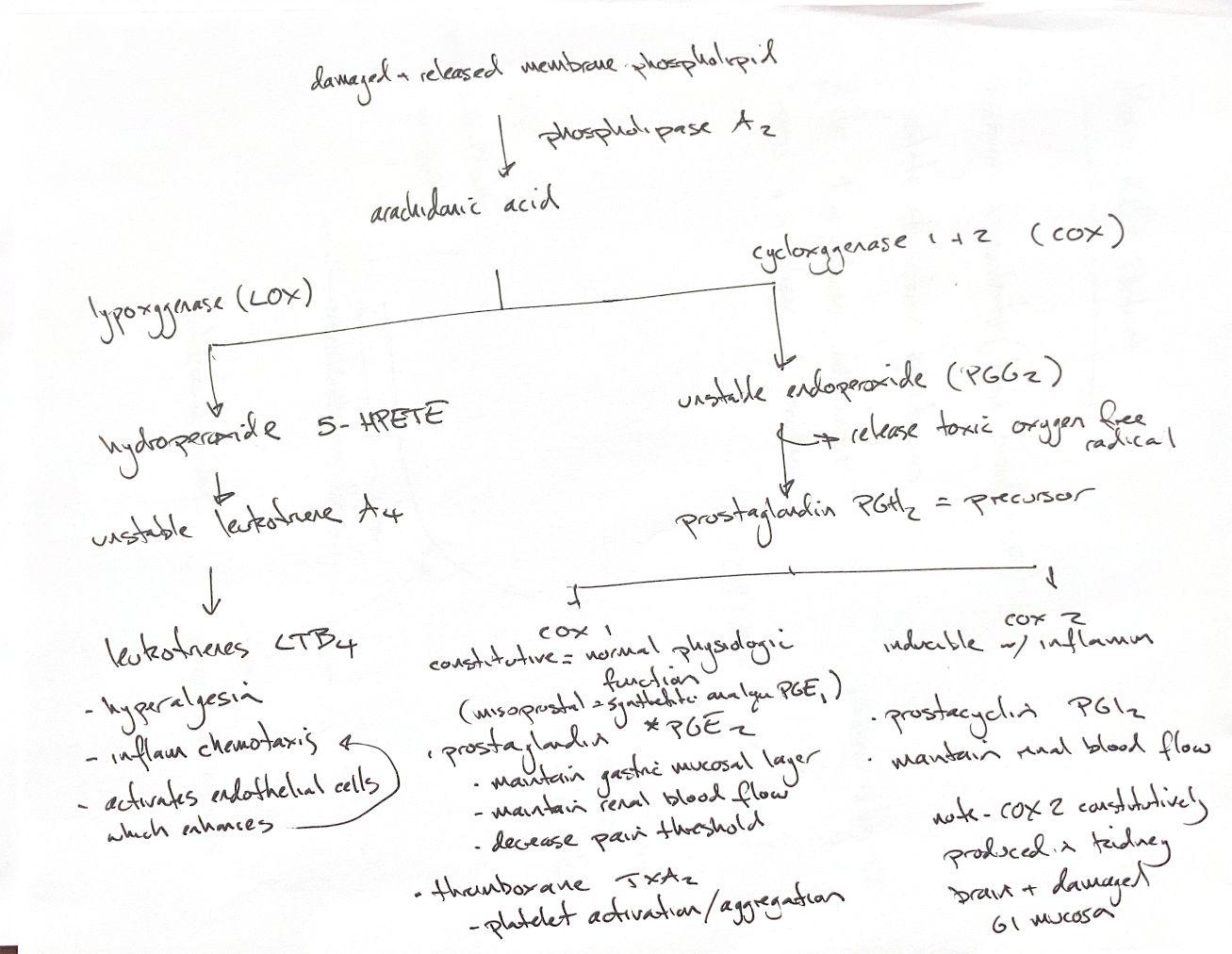
Cell activation or damage allows phospholipase A₂ to release arachidonic acid from membrane phospholipids. Two main routes then make lipid mediators.
The 5-lipoxygenase route forms 5-hydroperoxyeicosatetraenoic acid (5-HPETE), then unstable LTA₄ and LTB₄. LTB₄ attracts and activates inflammatory cells. It can contribute to hyperalgesia and activate endothelium so leukocytes adhere more readily.
Cyclooxygenase (COX)-1 and COX-2 act before the shared precursor PGH₂. This corrects their position in the original sketch. Their cyclooxygenase activity forms unstable PGG₂; peroxidase activity converts it to PGH₂. Tissue enzymes then make prostaglandins and thromboxanes. Oxidant formation can accompany this metabolism.
PGE₂ supports the gastric mucosal layer and renal blood flow. It also lowers the nociceptive threshold, so other stimuli hurt more. The original misoprostol memory cue refers to a synthetic PGE₁ analogue, not PGE₂. TXA₂ promotes platelet activation and aggregation. PGI₂, or prostacyclin, supports renal blood flow, dilates vessels and inhibits platelet aggregation.
COX-1 is largely constitutive and supports normal physiology. COX-2 is often induced by inflammation, but it is also constitutive in kidney and brain and supports repair in damaged gastrointestinal mucosa. Both isoforms feed the same PGH₂ pool. Their products are not a strict split between beneficial and inflammatory effects.
References
Chris Wood's ACVS notes; Johnston & Tobias, Veterinary Surgery: Small Animal, 2nd ed., ch. 1 and 68, supplied PDF pp. 89–90 and 2941–2944. Liu et al., J Biol Chem 2007;282:18233–18244, doi:10.1074/jbc.M701235200. Misoprostol prescribing information (PGE₁ analogue).