
Elastic plate osteosynthesis
Read the draft explanation
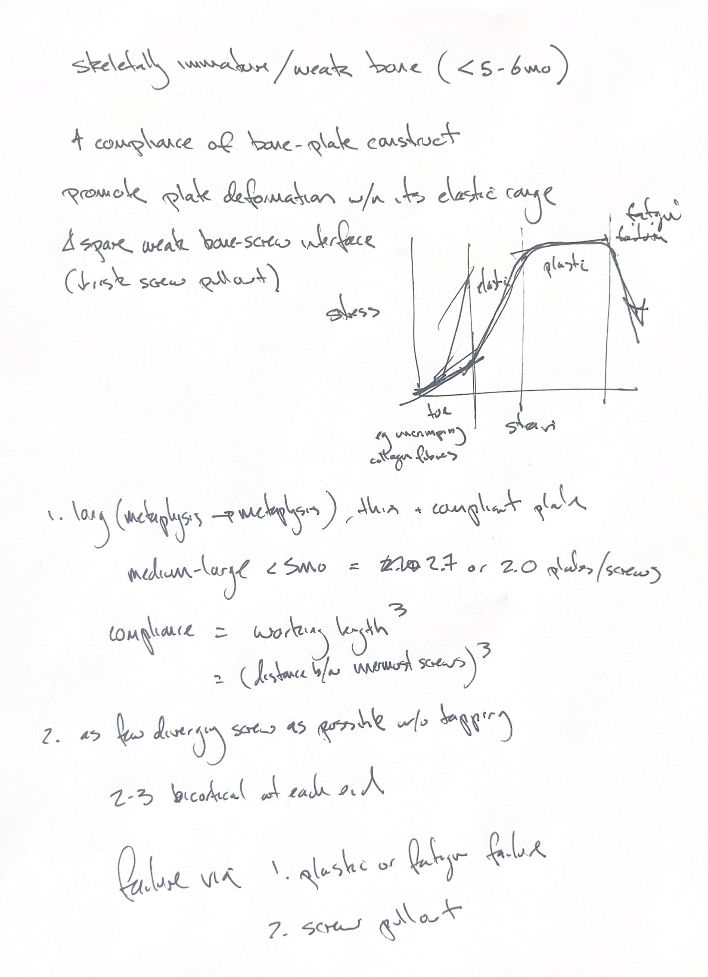
Elastic plate osteosynthesis lets a long, thin plate flex within its elastic range. This spreads load and helps protect the weak bone-screw interface in a growing animal. A very stiff plate can instead concentrate stress at that interface and lead to screw pullout.
This method suits skeletally immature animals, usually younger than 5-6 months. Age, weight, breed, activity and cortical thickness still guide selection. After about 6 months, bone behaves more like mature bone.
Span metaphysis to metaphysis and keep screws out of the physes. Preserve the fracture haematoma and periosteal sleeve. Use few divergent screws without tapping in the soft juvenile cortex, with two or three bicortical screws at each end.
Working length is the distance between the innermost screws. Increasing it lets the plate bend over a longer span. Compliance scales with L cubed and falls as plate area moment of inertia I or material modulus E rises. This is a model relationship for comparable loading. A thinner plate has lower I.
For medium- and large-breed dogs aged 5 months or younger, the described guide is a 2.0/2.7 veterinary cuttable plate with 2.0 or 2.7 mm screws. Sizing guidance is limited; excessive compliance can cause permanent plate bending. A short working length concentrates cyclic stress and raises fatigue risk. A short plate also increases pullout forces on the outer screws. The described central span has at least three consecutive empty holes.
The toe region in the tissue-curve memory cue reflects collagen uncrimping. Elastic deformation recovers after unloading; plastic deformation remains. Fatigue means damage from repeated loading and can occur below yield. It is not a separate region at the end of a single stress-strain curve.
References
Chris Wood's original study note; Johnston & Tobias, Veterinary Surgery: Small Animal, 2nd ed., Chapters 39 and 41 (supplied PDF pp. 1604-1607, 1684-1685).