
Locking plate mechanics and planning
Read the draft explanation
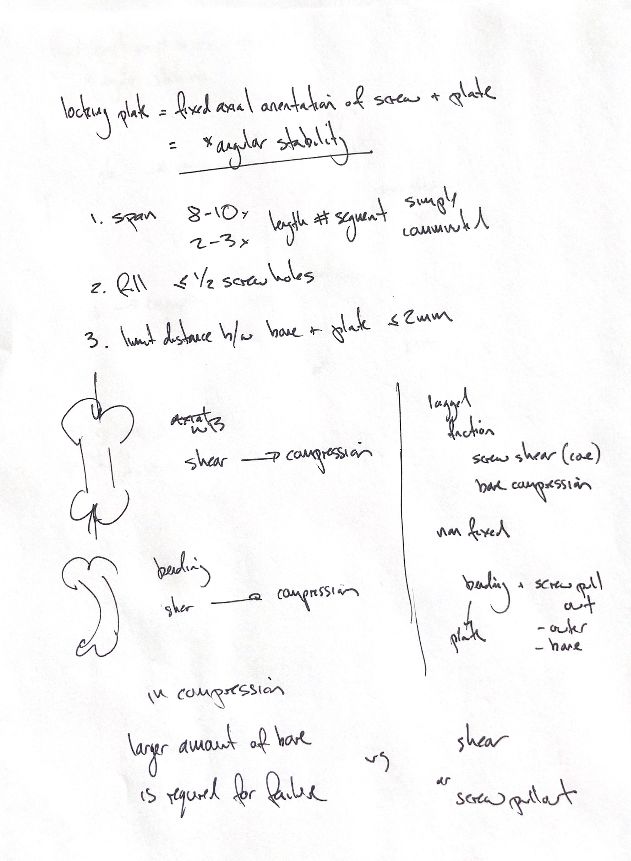
Locking the screw head to the plate fixes its angle. The plate and screws act together as an internal fixator, so stability does not depend on squeezing the plate against bone. This helps preserve the periosteal blood supply.
In conventional plating, axial load first meets friction; beyond that, screw-core shear and bone compression carry the load. Bending can tilt each screw and create pull-out, which depends on outer diameter and bone quality. Interfaces may fail one after another.
Angular stability changes that path. Axial and bending loads create compressive stress where locking screws bear on bone. Cortical bone resists compression better than shear. Failure requires a larger region of bone in compression or concurrent implant failure, rather than one screw pulling out first. Plate stiffness and fatigue still matter.
The span cues come from historical human bridge-plating guidance: plate length about 8–10 times the overall fracture-zone length for a simple fracture, and 2–3 times for a comminuted zone. The textbook also gives a general span greater than three times the fracture segment. That guidance keeps overall screw-to-hole density below 0.5, so fewer than half of all holes are occupied. Fracture gap, load sharing, bone quality and patient loading change the choice.
Keep the plate close to bone. The ≤2 mm offset cue comes from a composite-humerus bench model with a 10 mm gap and a seven-hole 4.5 mm LCP. Greater offset increases the screws' cantilever bending and can weaken fixation.
References
hand-drawn ACVS Phase One notes; Johnston & Tobias, Veterinary Surgery: Small Animal, 2nd ed., ch. 41. AO Technical Commission Innovations 2010, Principles of Bridge Plating. Ahmad et al., Injury 2007;38:358–364, doi:10.1016/j.injury.2006.08.058.