
DCP and LC-DCP mechanics
Read the draft explanation
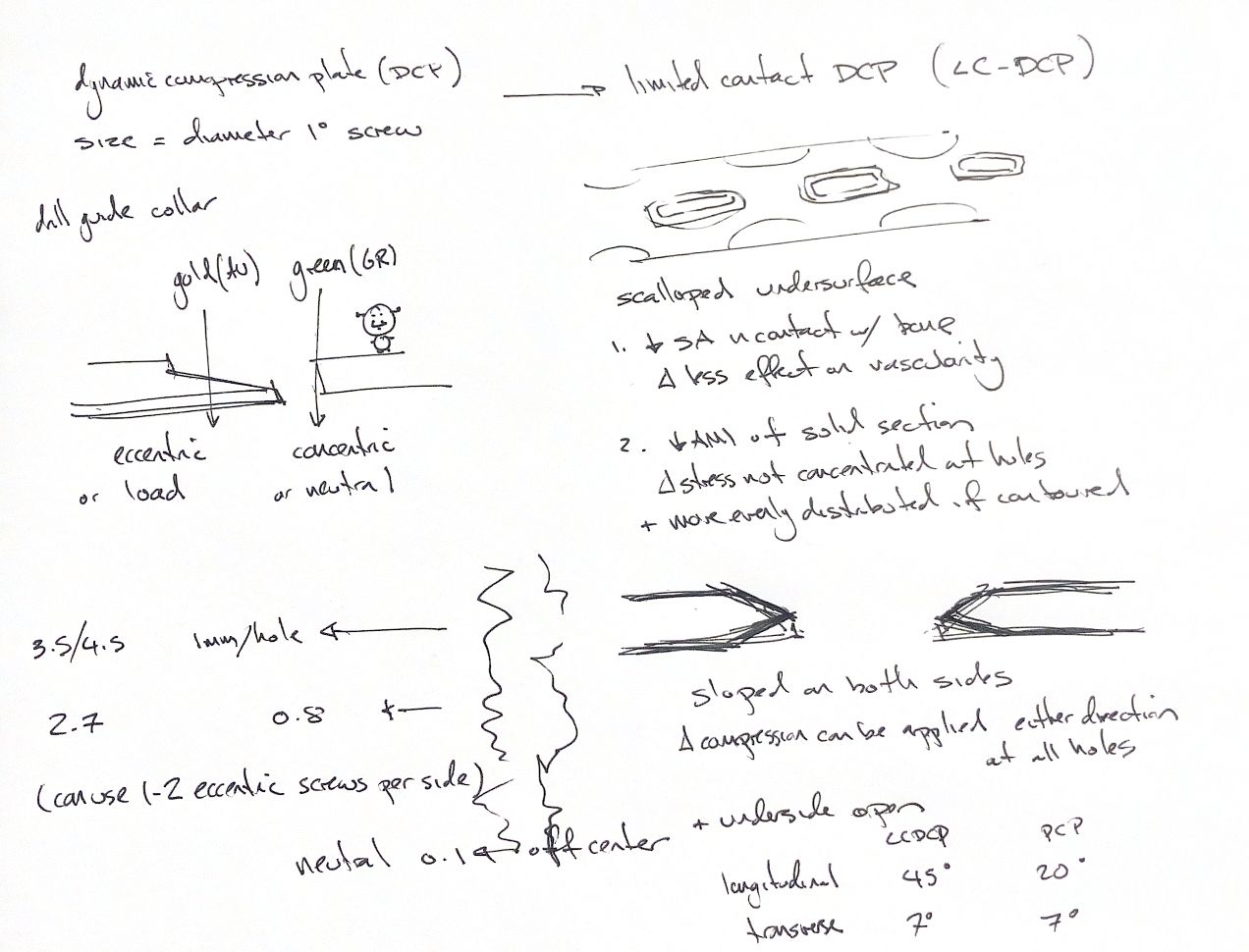
A dynamic compression plate uses a ramp inside an oval hole. Place a screw eccentrically away from the fracture. As its head slides down the ramp, it carries the engaged bone fragment toward the fracture. Contact between fragments turns that movement into compression. The system size names its primary screw diameter.
For classic DCP guides, gold means load and green means neutral. The neutral guide sits 0.1 mm off-centre, so it may add slight compression. Keep that detail separate from the LC-DCP green neutral guide, which does not generate compression. LC-DCP uses yellow for compression.
A 3.5 or 4.5 mm DCP permits up to 1.0 mm travel per hole; a 2.7 mm DCP permits up to 0.8 mm. These are travel capacities, not guaranteed gap closure. One or two eccentric screws may be used on either fracture side. For added travel, loosen the first screw so the plate can slide, load the next, then retighten.
LC-DCP scallops reduce bone contact and vascular compromise. Scalloping lowers the solid section’s area moment of inertia, or I. This makes bending and stress distribution more uniform. Symmetric hole ramps allow compression in either direction at any hole. The rounded underside permits greater screw angulation.
The original 20° DCP and 45° LC-DCP cues need correction. The AO manual and Synthes reference designs allow about 25° and 40° longitudinal inclination from perpendicular, respectively, with 7° transverse inclination each way. These are not total sweeps, and designs vary.
References
hand-drawn ACVS Phase One notes; Johnston & Tobias, Veterinary Surgery: Small Animal, 2nd ed., ch. 41. Koch, AO Principles of Fracture Management in the Dog and Cat (2005), ch. 2.1, pp. 36–39. Synthes, DCP and LC-DCP Systems Surgical Technique, 11/2022.