
Conventional plate load transfer
Read the draft explanation
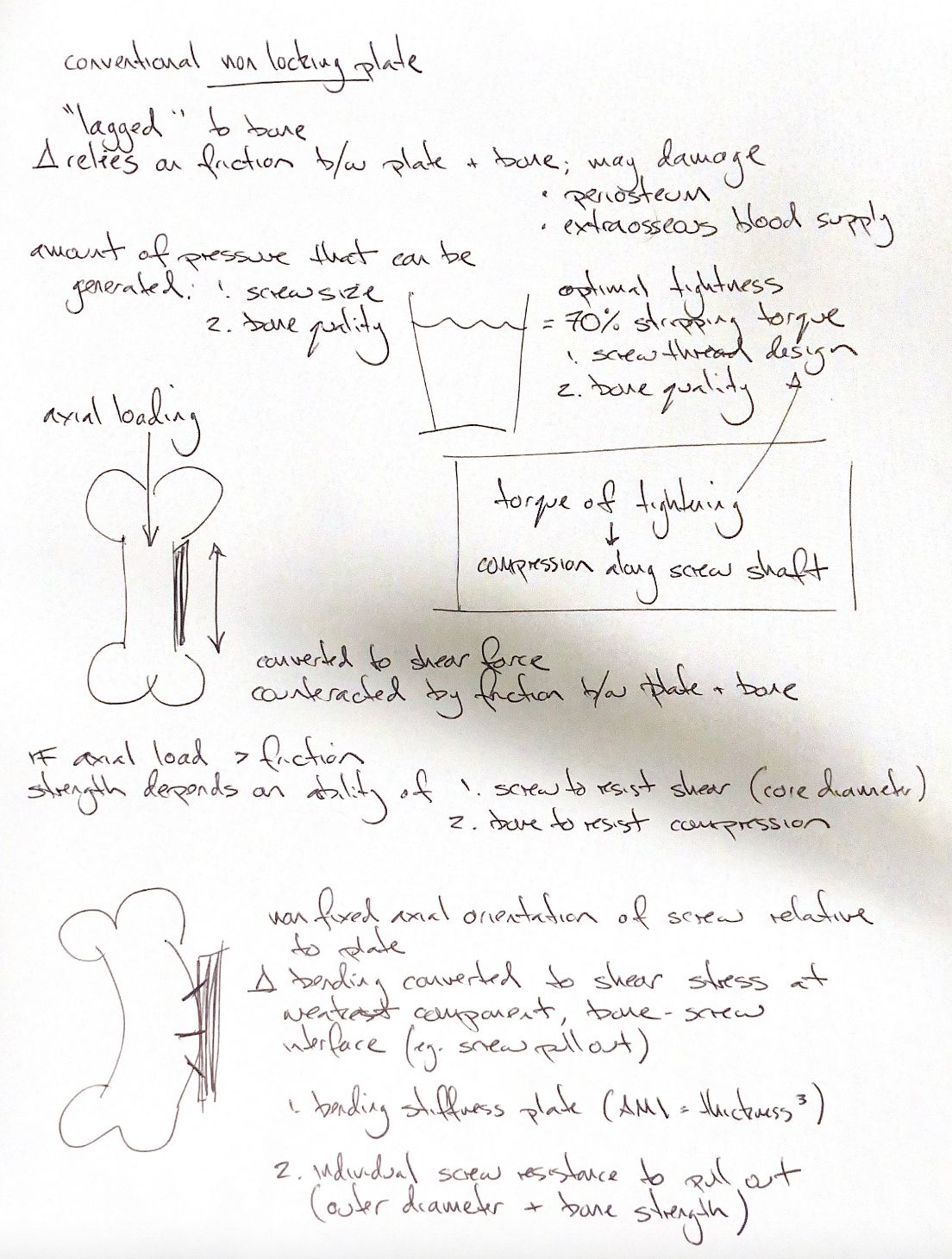
A conventional plate works by clamping against bone. Tightening each screw pulls the plate down. Friction at that contact surface resists sliding. The clamp force depends on screw size and bone quality. Tight contact can also compromise the periosteum and extraosseous vessels.
The textbook's roughly 70% stripping-torque cue describes submaximal tightening. Stripping torque depends on bone thickness, quality and thread design. It is not a universal clinical target. The cited human cadaveric-humerus study tested 3.5 mm screws at 50%, 70% and 90% of maximum torque. No level gave significantly better pull-out strength; tightening beyond 50% added no pull-out benefit in that model.
Axial loading creates shear at the plate–bone interface. Friction counters that shear. Once the load exceeds friction, the screw must resist shear and the surrounding bone must resist compression. A larger screw core improves shear resistance.
Bending creates a different problem. The screw head is free to change angle relative to the plate, so the load can become pull-out and shear along the bone–screw interface. Resistance depends on plate bending stiffness and each screw's purchase. For the same plate width, area moment of inertia scales with thickness cubed. Pull-out resistance depends mainly on screw outer diameter and the quality and thickness of the engaged bone. The bone–screw interface is usually the weak link.
References
hand-drawn ACVS Phase One notes; Johnston & Tobias, Veterinary Surgery: Small Animal, 2nd ed., ch. 41. Tankard et al., J Orthop Trauma 2013;27:232–235, doi:10.1097/BOT.0b013e318279791f.