
Implant size and canal-fill reference
Read the draft explanation
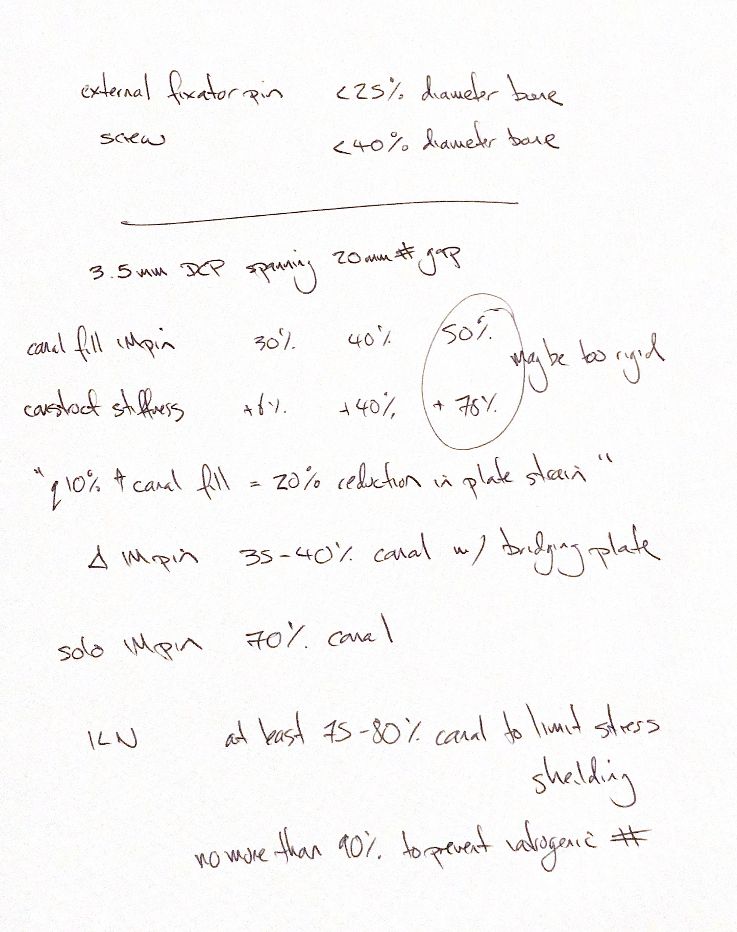
Choose the denominator first. ESF pin diameter should stay at or below 25% of outer bone diameter at the insertion site. A cortex screw should stay at or below 40%. Canal fill uses the implant diameter divided by the medullary canal diameter, rather than the outer bone width.
In an in vitro model, a 3.5 mm DCP bridged a 20 mm fracture gap. Rods filling 30%, 40% and 50% of the canal increased construct stiffness by 6%, 40% and 78%, respectively, compared with the plate alone. Each 10 percentage-point increase in fill reduced plate strain by about 20% in that model. A 50% rod may make a plate–rod construct too rigid for the desired micromotion.
A 35–40% canal-diameter pin is a reference for use with a bridging plate. When the pin is the only intramedullary device, at least 70% fill gives better bending support. Smooth pins resist axial and rotational forces poorly, so most shaft fractures need another means of control.
Size an interlocking nail at the canal isthmus on calibrated orthogonal radiographs. General upper fill limits vary from 70% to 90%; oversizing risks iatrogenic fracture. About 75% is an angle-stable nail reference used to limit stress shielding. A 75–80% fill is not a universal minimum for every nail. Use the chosen system’s planning guidance.
References
Johnston & Tobias, Veterinary Surgery: Small Animal, 2nd ed., chs. 41–42. Hulse et al. (2000), doi:10.1055/s-0038-1632658. Koch, AO Principles of Fracture Management in the Dog and Cat (2005), ch. 2.1. AO Surgery Reference, external skeletal fixation.