
Wire gauges and cerclage loop mechanics
Read the draft explanation
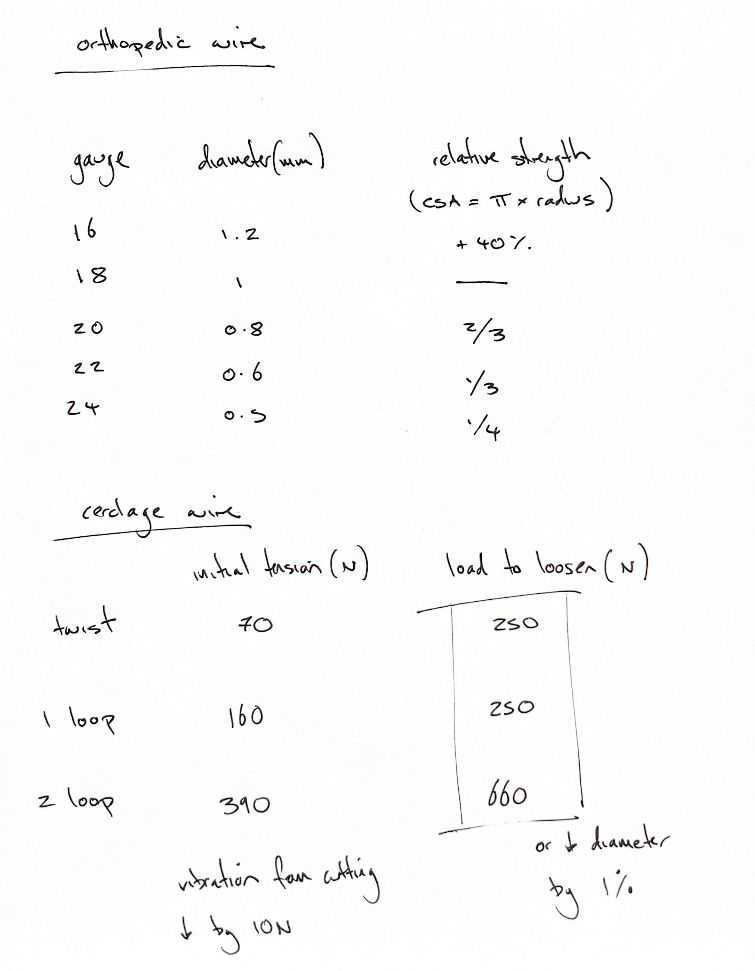
Wire diameter matters because tensile strength follows cross-sectional area: πr². Using the source table's nominal sizes, 18 gauge is the 1.0 mm baseline. A 1.2 mm, 16-gauge wire is about 40% stronger; 0.8 mm is 0.64×, 0.6 mm is 0.36× and 0.5 mm is 0.25×. The two-thirds, one-third and one-quarter cues are handy approximations. Gauge names alone do not replace checking the stated diameter. The knot is often the weakest part.
Initial tension is the compression left after tying. Load before loosening asks how much extra load a knot can take before that tension is lost. The rough memory figures are 70/160/390 N initially and 250/250/660 N before loosening for twist, single-loop and double-loop knots. Twist starts lower than single loop, yet both loosen at similar loads. Double loop starts tighter and resists more load. These are bench results, not patient load limits.
Roe tested 18 cerclages of each type for initial tension. Six per type underwent the stepwise load-and-unload test; the jig returned to its starting position after each load. A resting tension below 30 N meant the cerclage was loose. Another six per type underwent collapse testing. Reducing the simulated bone diameter by only about 1% could release the tension; the abstract states that a reduction greater than 1% loosened every type. This refers to collapse of the structure inside the loop, not thinning the wire. Complete fragment contact is what keeps the loop tight.
References
hand-drawn ACVS Phase One notes; Johnston and Tobias, Veterinary Surgery: Small Animal, 2nd edition, Chapter 41, Tables 41.1–41.2. Roe, Vet Surg 1997;26:310–316. https://pubmed.ncbi.nlm.nih.gov/9232789/