
Cerclage reconstruction and twist technique
Read the draft explanation
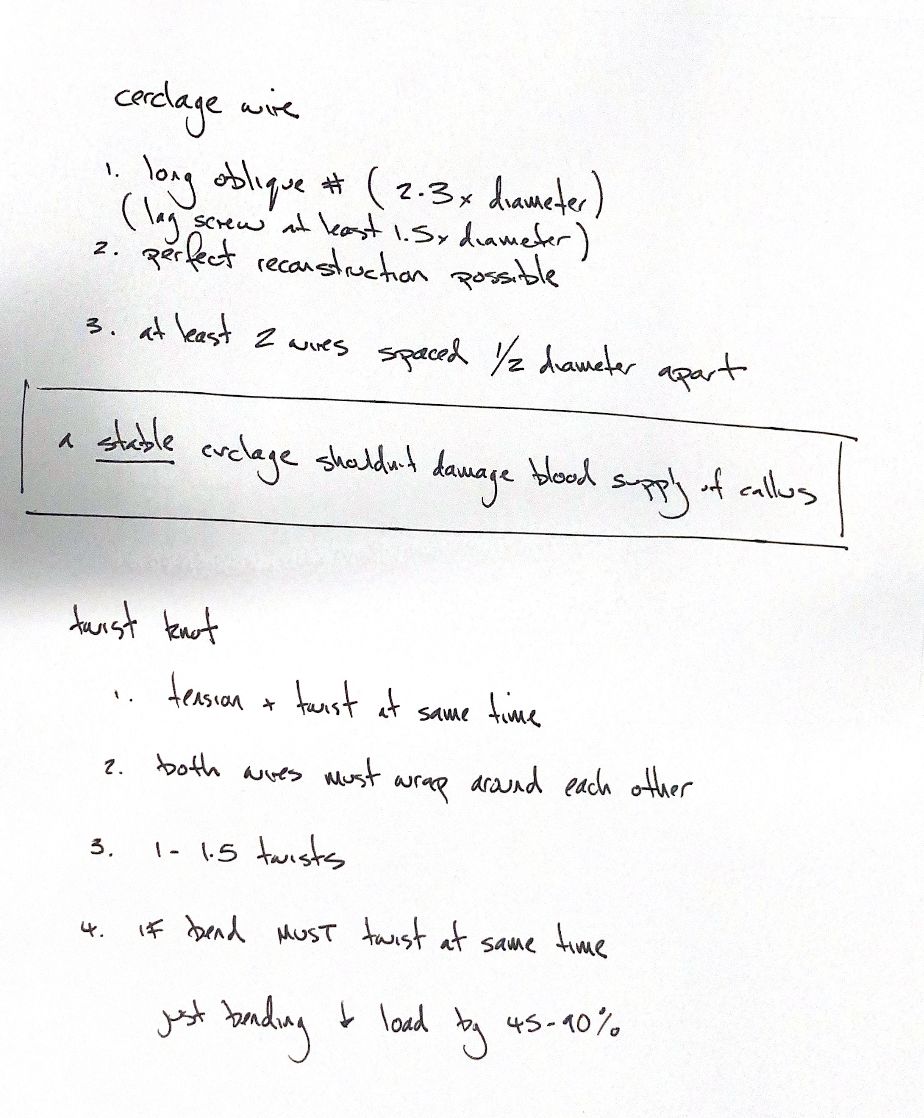
Cerclage works best when every piece of the bone can be brought back into contact. The long-oblique pattern gives the wire something to compress. The 2–3× bone-diameter cue is a rough guide; the textbook describes full cerclage as easiest at about 2.5–3×. The lag-screw comparison is about access: below roughly 1.5×, an effective screw perpendicular to the fracture becomes difficult to place.
Rebuild the whole circumference. Use at least two wires, spaced about half a bone diameter apart. A missing fragment lets the construct collapse and the wire loosen. Stable, well-placed cerclage need not impair the callus blood supply. Loose wires and tissue damage during application are different problems. Cerclage usually supplements a primary implant that protects the repair from loading.
Pull evenly as you twist, so both strands wind around each other. A short, secure twist avoids a long end that irritates tissue. The 1–1.5-turn memory cue reflects the textbook's differing descriptions: one turn in the figure and 1½ in the text. It is not a universal count for every wire and technique. If the twist must lie flat, combine that movement with the final tightening turn. Do not finish the knot and then simply push it down.
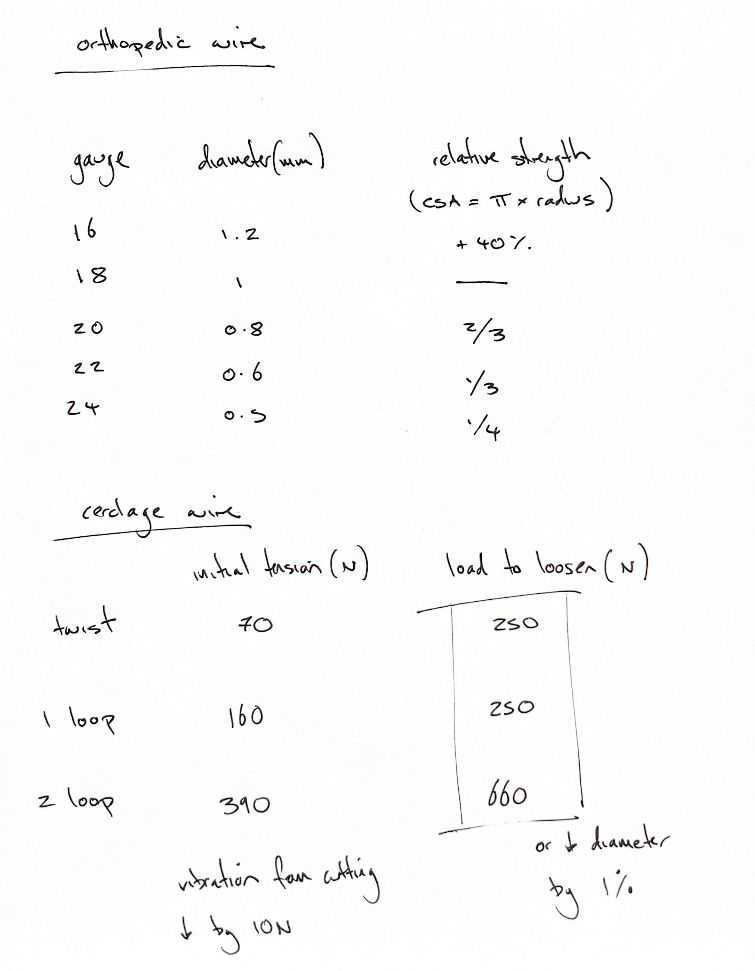
That last bend can release much of the tension. In a human femoral-shell jig study, bending 1.25 mm wire twists lost 45–90% of pretension, depending on direction, with five specimens per direction. This measured resting tension, not clinical failure risk. Cutting vibration also caused about a 10 N drop in preliminary jig trials described in the textbook. Keep the wire steady while cutting and avoid unnecessary handling of the finished twist.
References
hand-drawn ACVS Phase One notes; Johnston and Tobias, Veterinary Surgery: Small Animal, 2nd edition, Chapter 41. Wähnert et al., Acta Chir Orthop Traumatol Cech 2011;78:208–214. https://achot.actavia.cz/pdfs/ach/2011/03/04.pdf