
Screw anatomy and cortical-cancellous differences
Read the draft explanation
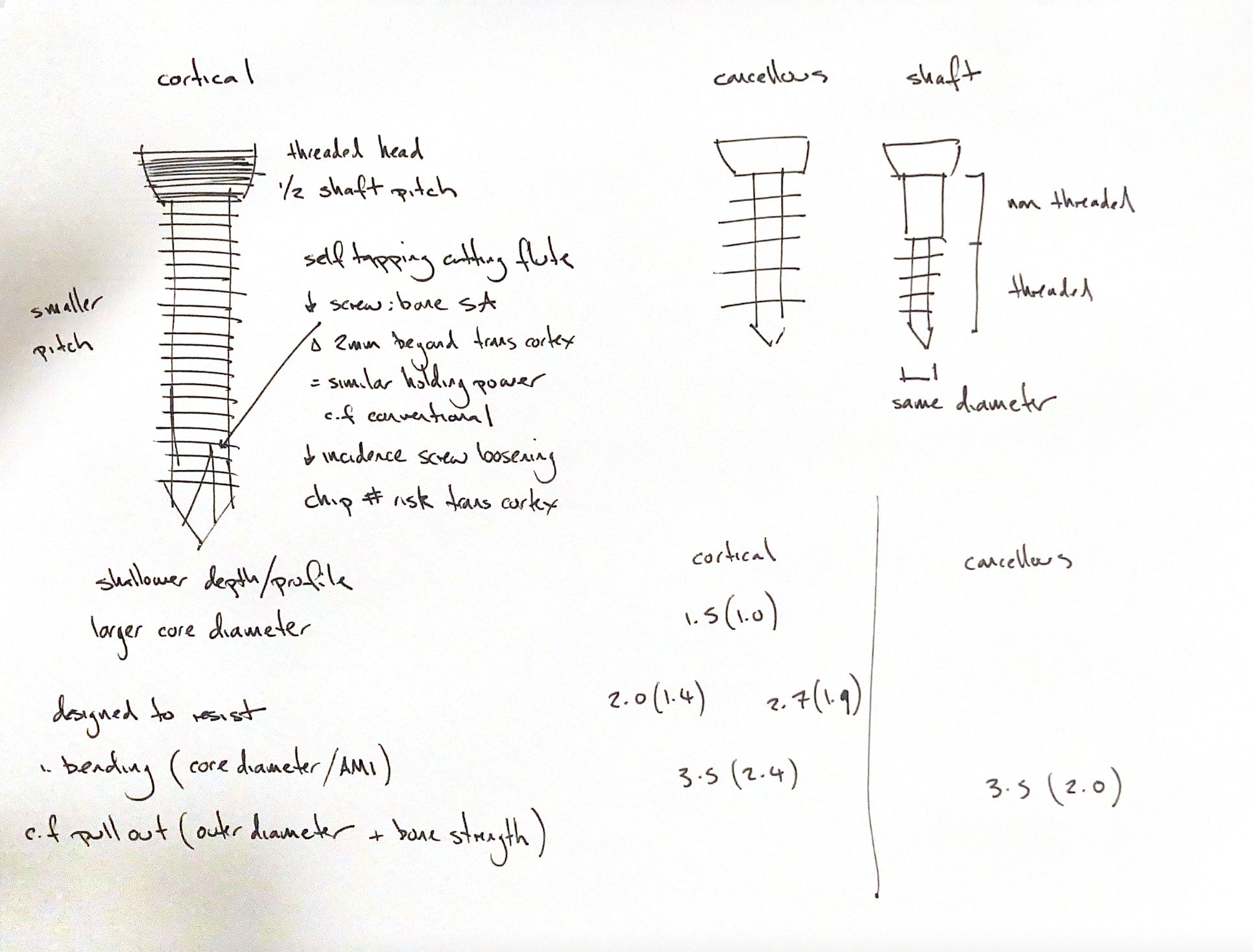
Cortical and cancellous screws match different bone. Cortical threads sit closer together and have a shallower profile. At the same outer diameter, this leaves a larger core. Cancellous threads are deeper and farther apart. They grip trabecular bone.
A shaft screw has cortical threads at its far end. Its smooth shaft matches the outer thread diameter. It fills the near-cortex glide hole and is stronger in bending. Cancellous screws may be fully or partly threaded. Partial threads create a lag effect only when they engage the far fragment alone.
Locking and self-tapping describe different features. Head threads can lock into a plate. In many double-lead locking designs, head pitch is half the shaft pitch. A larger core and shallower shaft threads help resist bending and shear. Other locking systems use different head connections.
A self-tapping tip cuts its own bone threads. Its flutes reduce bone–screw contact. They must clear the far cortex for full thread purchase. The 2 mm drawing is the textbook's example, not a length rule for every implant. In canine femoral testing, fully inserted self-tapping and pre-tapped screws had similar pull-out strength. Incomplete self-tapping insertion reduced holding power.
Less loosening was reported six weeks after TPO in a retrospective study of 62 dogs using 3.5 mm screws. Far-cortex chip fractures can still occur. In hard, thick cortex, debris can fill the short cutting flutes and impair cutting.
Core size matters for bending. The area moment of inertia rises with radius to the fourth power. Pull-out resistance depends mainly on outer diameter and bone strength. The table keeps the legacy outer/core pairs in my notes. Dimensions vary by design: the legacy 1.5 mm cortical core is 1.0 mm, while the 2016 Synthes Vet example is 1.1 mm. Core size and pilot-drill size are separate measurements.
References
Johnston & Tobias, Veterinary Surgery: Small Animal, 2nd ed., ch. 41, Figs 41.18–41.22; Murphy et al., Vet Surg 2001, doi:10.1053/jvet.2001.23344; Béosier et al., VCOT 2010, doi:10.3415/VCOT-09-02-0013; Boekhout & Cross, Vet Surg 2012, doi:10.1111/j.1532-950X.2012.01034.x; DePuy Synthes Vet Catalogue, 12/16.