
Fresh autogenous graft harvest reference
Read the draft explanation
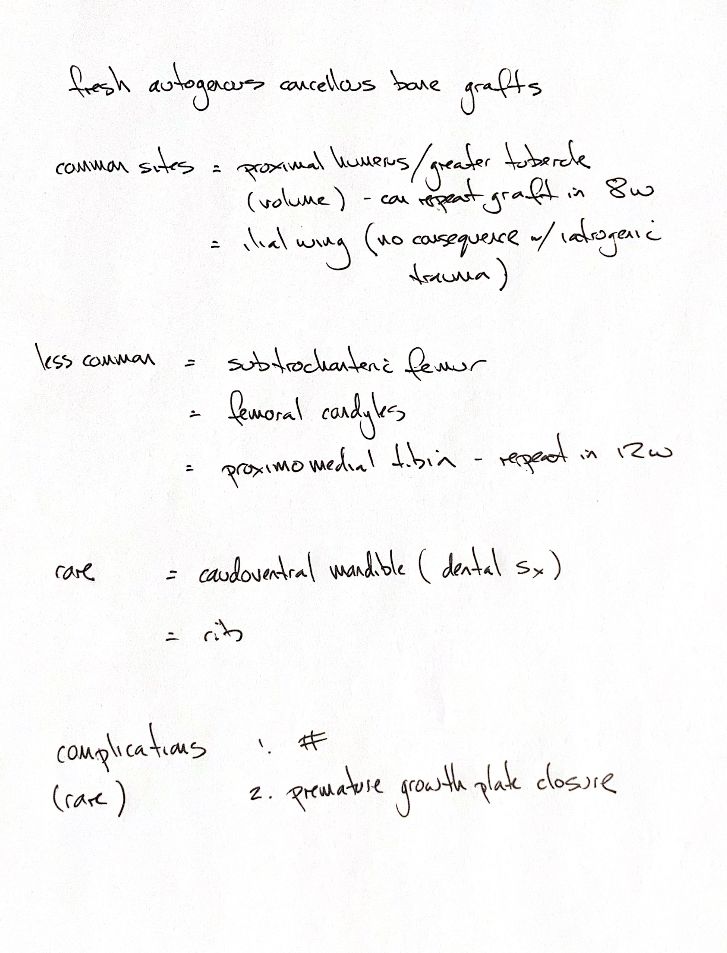
Fresh autogenous cancellous graft comes from the patient’s own bone. Common donor sites in dogs are the proximal humerus, at the greater tubercle, and the wing of the ilium. The humerus offers a useful volume of cancellous bone. The iliac wing avoids creating a donor defect in a weight-bearing long bone.
Less common sites are the subtrochanteric femur, femoral condyles and proximomedial tibia. The caudoventral mandible is used less often, mainly for dental or periodontal surgery. A rib is another rare donor site.
Reported repeat-harvest intervals in adult dogs are 8 weeks at the proximal humerus and at least 12 weeks at the proximal tibia. These are donor-site healing cues. Assess recovery at the individual site before collecting again. Humeral cancellous bone restored faster and more completely than tibial bone in the comparative donor-site study.
Harvest complications are rare in dogs, but fracture and premature growth plate closure have been reported. Protect the physis when harvesting from growing patients.
References
Johnston & Tobias, Veterinary Surgery: Small Animal, 2nd ed., ch. 48. Penwick et al., Vet Surg 1991; 20:229–234, doi:10.1111/j.1532-950X.1991.tb01251.x. Johnson, AJVR 1988; 49:885–888, PMID 3041884.