
Demineralised bone matrix preparation
Read the draft explanation
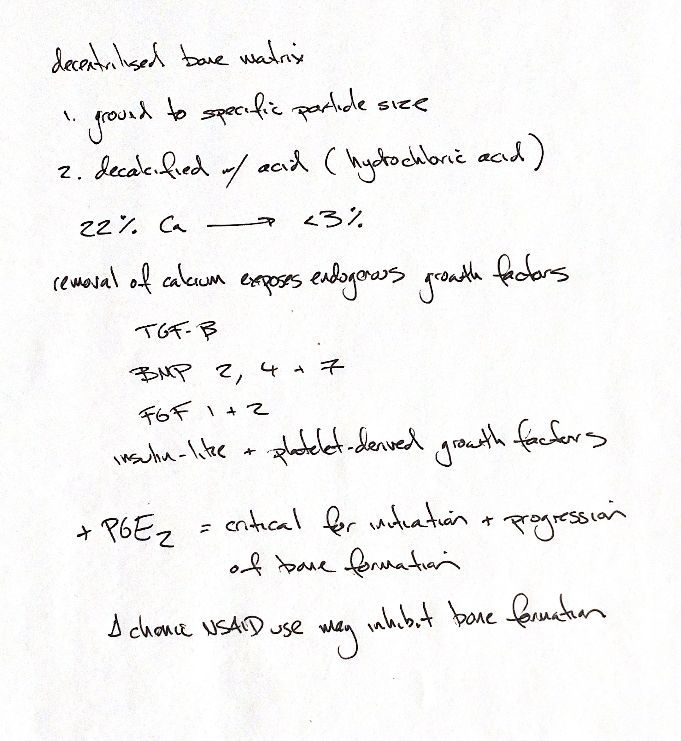
DBM starts as bone ground and sieved to selected particle sizes. Acid, usually hydrochloric acid, removes much of the mineral. The textbook describes calcium content in canine bone falling from about 22–25% to below 3%. These figures describe the bone, not the acid concentration.
Removing mineral exposes signals already held in the matrix: TGF-β; BMP-2, BMP-4 and BMP-7; FGF-1 and FGF-2; insulin-like growth factors; and platelet-derived growth factors. These signals help recruit and direct host progenitor cells toward osteoblasts and new bone. DBM supplies no living donor cells, and its inductive activity varies with preparation.
Prostaglandin E₂ supports the start and progression of bone formation. Chronic NSAID exposure may inhibit bone formation. The effect depends on the drug, dose, timing and model. Rat experiments show that responses differ between drugs and schedules; they do not establish a universal effect in canine patients.
References
Johnston & Tobias, Veterinary Surgery: Small Animal, 2nd ed., ch. 48. Yazdi et al. (1992), doi:10.1111/j.1600-0765.1992.tb02082.x. Simon & O’Connor (2007), doi:10.2106/JBJS.F.00127.