
Graft-material properties
Read the draft explanation
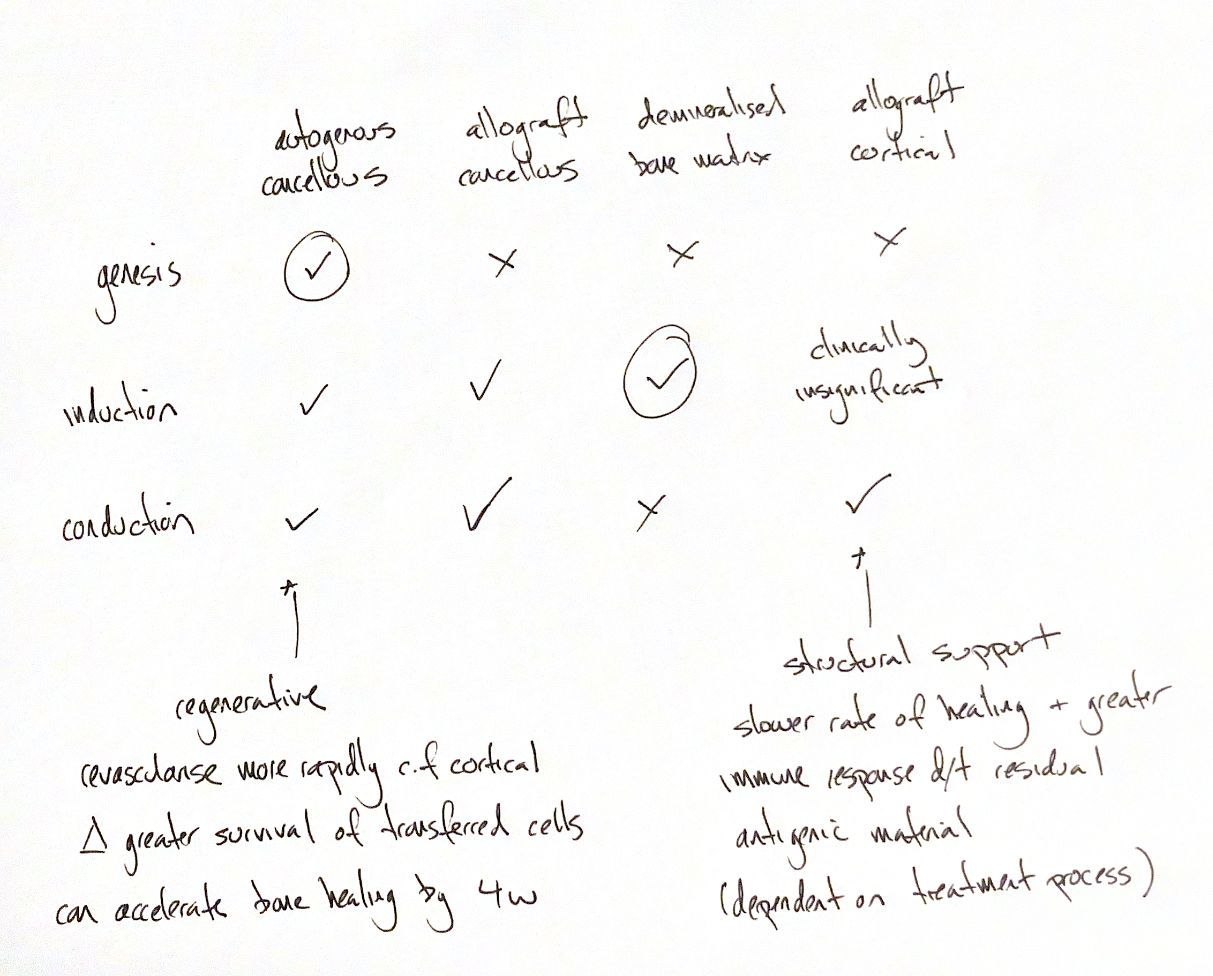
Osteogenesis supplies living bone-forming cells. Osteoinduction recruits and directs cells toward bone formation. Osteoconduction gives them a scaffold.
Fresh cancellous autograft contributes all three. Processed cancellous allograft lacks viable donor cells, but can provide inductive signals and a porous scaffold. DBM is mainly inductive; its scaffold contribution depends on formulation. Cortical allograft is osteoconductive and mainly structural. Its induction is usually clinically insignificant.
Fresh cancellous autograft revascularises faster than fresh cortical autograft, helping some transferred cells survive. Cortical allograft incorporates slowly. Residual antigens can increase its immune response, and processing affects that burden.
The textbook reports healing gains of up to 4 weeks with cancellous autograft. Its cited experiment compared grafted and ungrafted carpi in 8 dogs and found greater histological healing at 12 weeks. The exact 4-week gain cannot be confirmed from that abstract or predicted for every fracture.
References
Johnston & Tobias, Veterinary Surgery: Small Animal, 2nd ed., ch. 48. Johnson & Bellenger (1980), doi:10.1136/vr.107.6.126. Gebhart & Lane (1991), PMID:1872156. Song et al., doi:10.1007/s10561-022-10025-5.