
Four actions of bone grafts
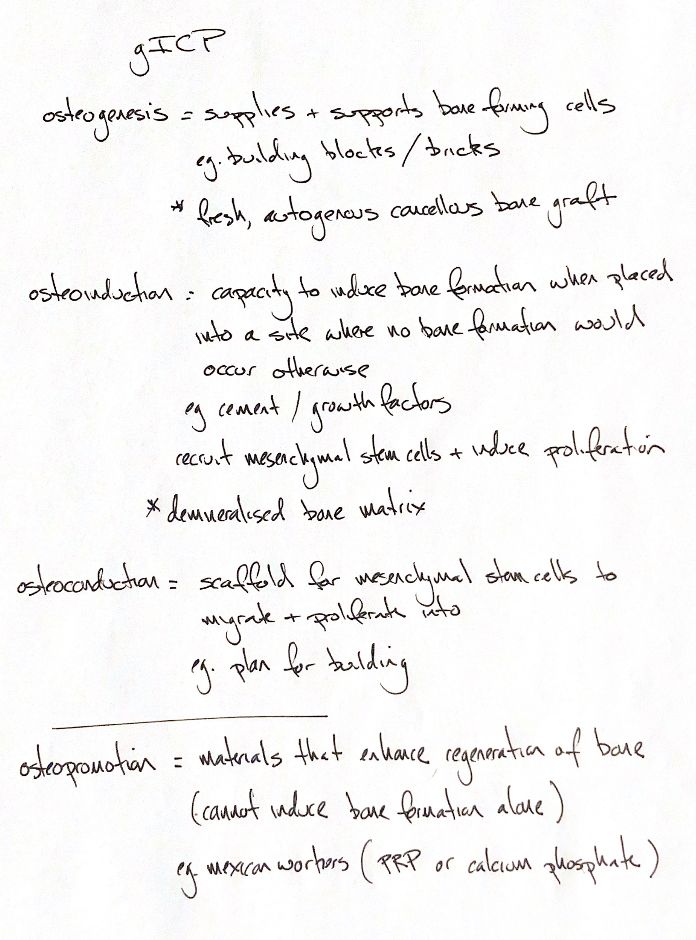
Read the draft explanation
Use your building analogy to separate four graft actions: genesis, induction, conduction and promotion. A graft can have more than one action.
Osteogenesis supplies and supports living bone-forming cells. These are your building blocks or bricks. Fresh autogenous cancellous bone graft is the example: it carries osteoblasts on the trabeculae and cells within its marrow. Autogenous means the graft comes from the same patient.
Osteoinduction is the capacity to induce bone where it would not otherwise form. Your cement cue stands for growth-factor signals. They recruit mesenchymal stem cells and their progeny, then stimulate proliferation and differentiation into cells of the regenerating callus. Demineralised bone matrix, or DBM, is the example. Its active matrix signals are distinct from simply transferring living cells.
Osteoconduction provides a scaffold for cells to migrate into and proliferate along. This is your building plan or framework. Interconnected spaces also allow blood vessels to grow in. The scaffold guides ingrowth; it does not mean the material must provide structural fixation.
Osteopromotion enhances regeneration that is already underway. Your workers cue helps recall that supporting role. The textbook lists platelet-rich plasma, PRP, and calcium phosphate among the examples. An osteopromotive stimulus cannot induce bone formation on its own.
These categories describe actions, rather than exclusive boxes for products. Calcium phosphate can also provide an osteoconductive framework. Fresh cancellous autograft combines living cells, matrix signals, a scaffold and the effects of the associated clot. It brings several parts of the build together.
References
hand-drawn ACVS Phase One notes; Johnston and Tobias, Veterinary Surgery: Small Animal, 2nd edition, Chapter 48.