
Stability and implant roles
Read the draft explanation
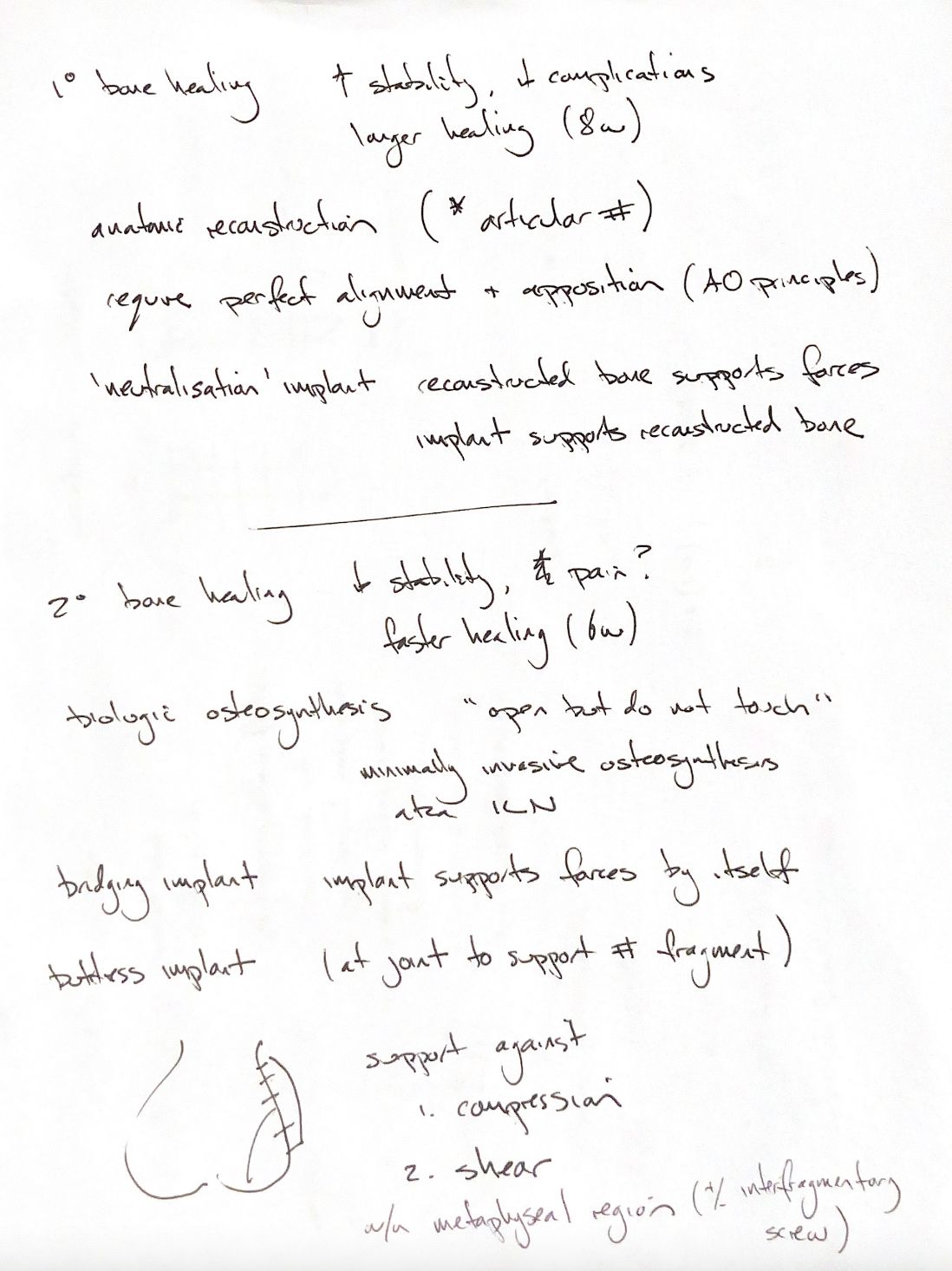
Primary and secondary healing need different mechanical environments. Primary healing needs accurate reduction, close apposition and rigid fixation. This gives absolute stability and direct bone formation. Restoring the joint surface is especially important in articular fractures.
A neutralisation plate protects a reconstructed bone column. Bone and implant share the load. A bridge spans a zone that cannot share load, so the implant carries that load until a callus bridges and matures.
Biological osteosynthesis preserves the fracture haematoma, blood supply and soft tissues. The aim is alignment and relative stability, without stripping and rebuilding every fragment. Think “open but do not touch”, or a minimally invasive approach. Interlocking nails and bridging plates can serve this role.
A buttress plate has a different job. It acts like a retaining wall beside a metaphyseal fragment, often near a joint. It resists compression and shear that would displace the fragment. Interfragmentary screws may be added.
The 8-week versus 6-week cue comes from a specific comparison. Horstman and colleagues studied 20 dogs with comminuted long-bone fractures, all fixed with interlocking nails. Median healing was 8 weeks after anatomic repair in 11 dogs and 6 weeks after biological repair in 9. Complication rates did not differ significantly. These are study medians, not fixed clocks for primary and secondary healing. Greater rigidity does not itself establish a higher complication rate, and the healing label alone does not predict pain.
References
Johnston & Tobias, Veterinary Surgery: Small Animal, 2nd ed., Chs. 39 and 41. Horstman et al. 2004: https://doi.org/10.1111/j.1532-950X.2004.04034.x