
Bone modelling and remodelling
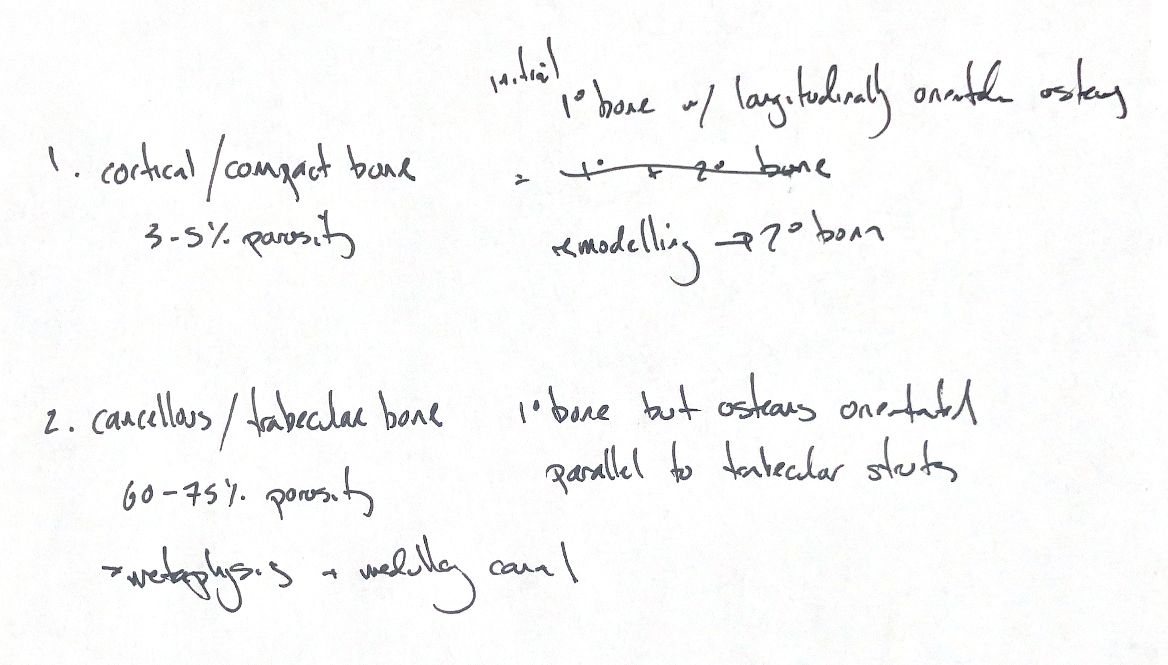
Read the draft explanation
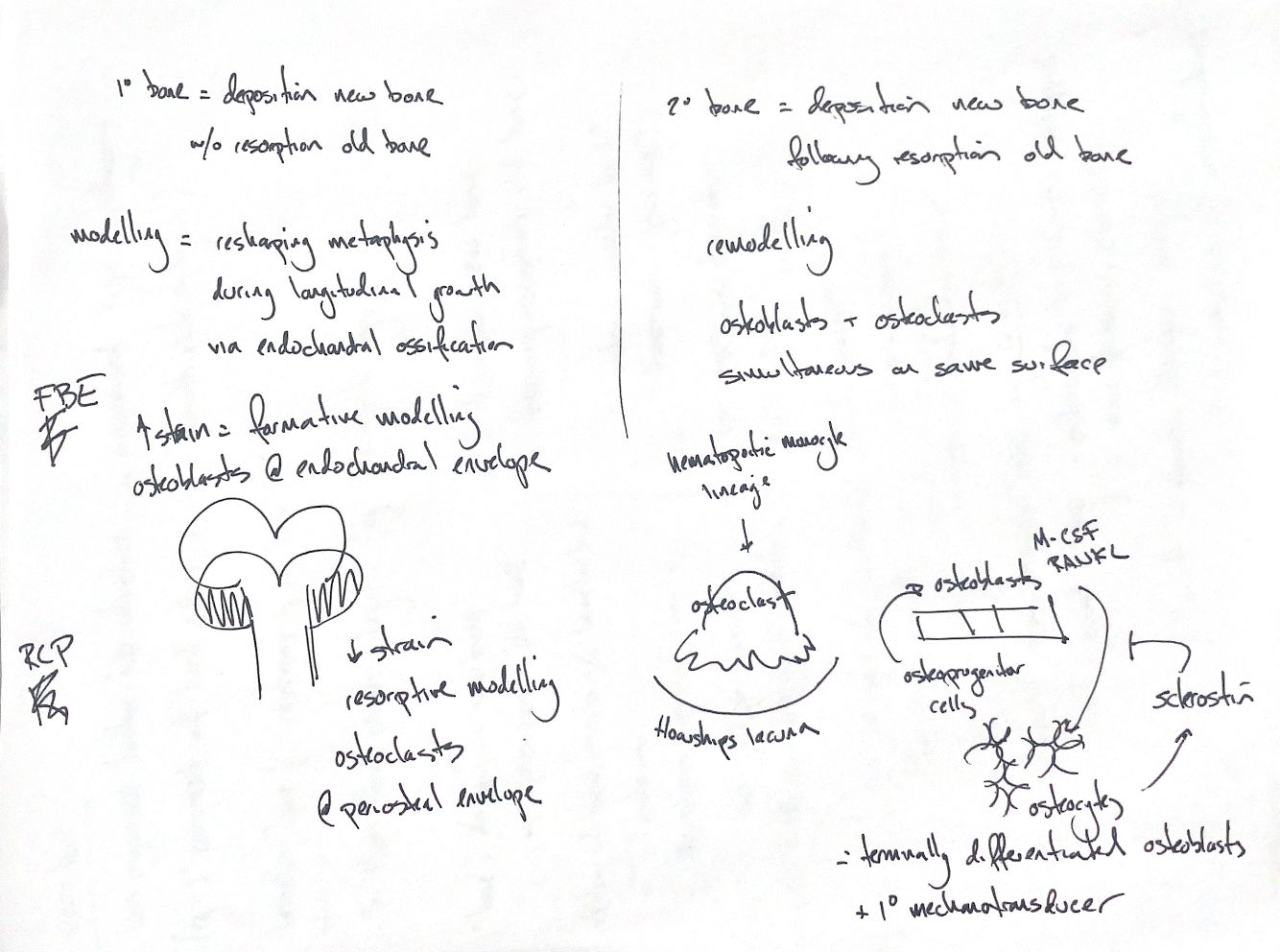
Modelling changes a bone's shape. Osteoblasts add new bone, while osteoclasts remove bone from other surfaces. Those activities are coordinated, but they do not have to form a replacement cycle at the same spot.
During longitudinal endochondral growth, the broad metaphysis must be reshaped as the bone lengthens. In this metaphyseal example, osteoclasts remove bone from the periosteal surface while osteoblasts add it along the endocortical surface. This funnels the growing region towards the narrower shaft. It is a regional growth pattern; it does not mean every periosteal surface always loses bone.
Keep the FBE and RCP cues from the sketch: formation, osteoblasts, endocortical; resorption, osteoclasts, periosteal. These belong to the metaphyseal example.
Local strain guides adaptation. Higher strain can stimulate formation; reduced strain can favour resorption. The response depends on the site and loading.
Remodelling replaces existing bone at the same site. Osteoclasts resorb it, a reversal phase prepares the surface, and osteoblasts deposit new bone. These steps are coordinated in sequence. The shorthand “simultaneous” should not be read as both cells working on the same piece of surface at once.
Osteoclasts come from the haematopoietic monocyte lineage. They are multinucleated and create resorption pits called Howship's lacunae. Osteoprogenitors become osteoblasts. Signals from osteoblast-lineage cells, including M-CSF and RANKL, support osteoclast formation; this signal does not turn an osteoblast into an osteoclast.
Some osteoblasts become enclosed in matrix and differentiate into osteocytes. Osteocytes are the main mechanotransducers: they detect mechanical signals and help control turnover. Their sclerostin inhibits osteoblast activity. This links loading, local cell signals and replacement of old bone with new secondary bone.
References
hand-drawn ACVS Phase One notes; Johnston & Tobias, Veterinary Surgery: Small Animal, 2nd ed., Chs. 38–39, bone cells, modelling and remodelling.