
Bone organisation: woven, lamellar and osteons
Read the draft explanation
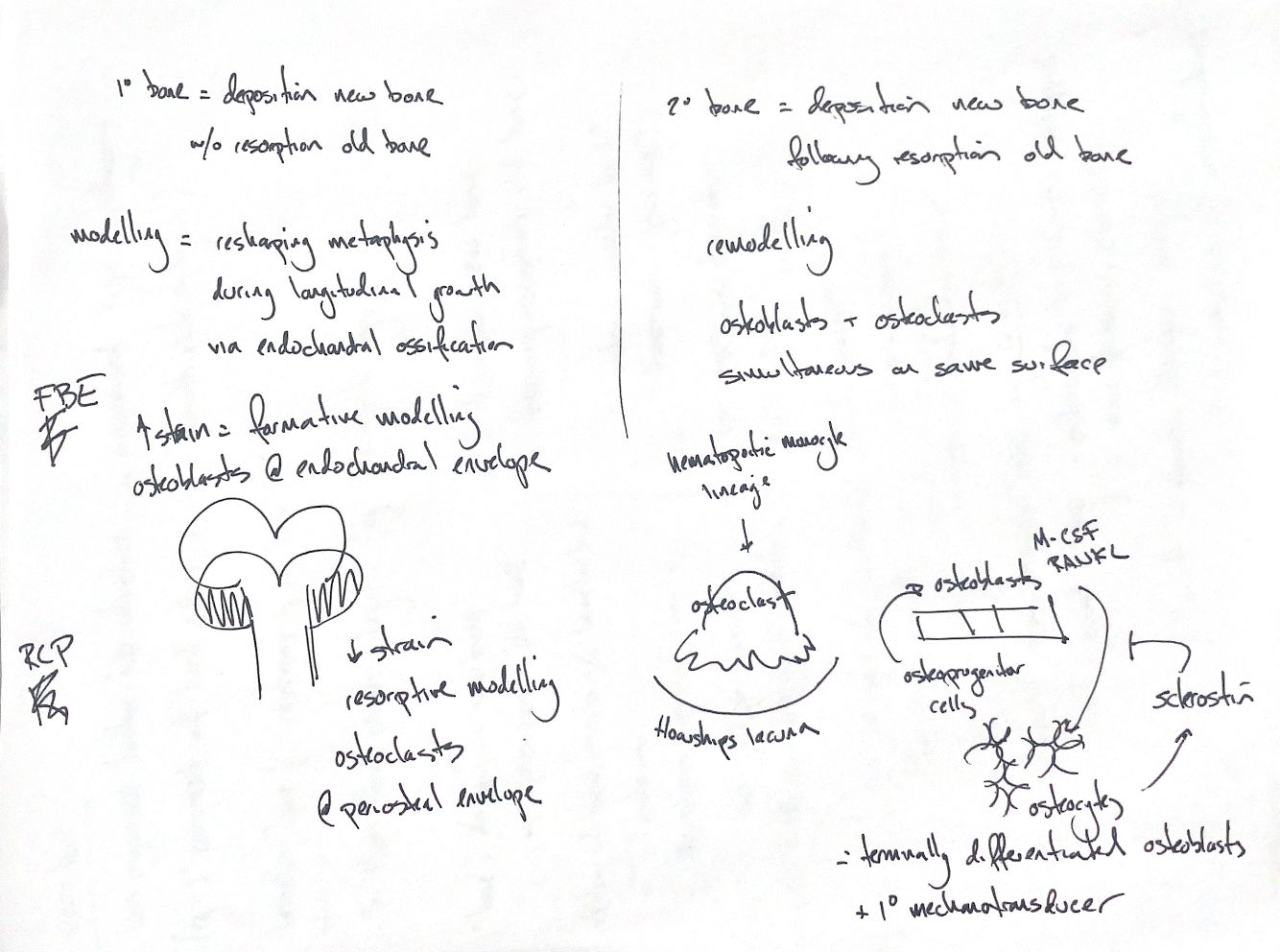
Bone names describe different things. Woven and lamellar describe how the matrix is organised. Primary and secondary describe how that bone was formed.
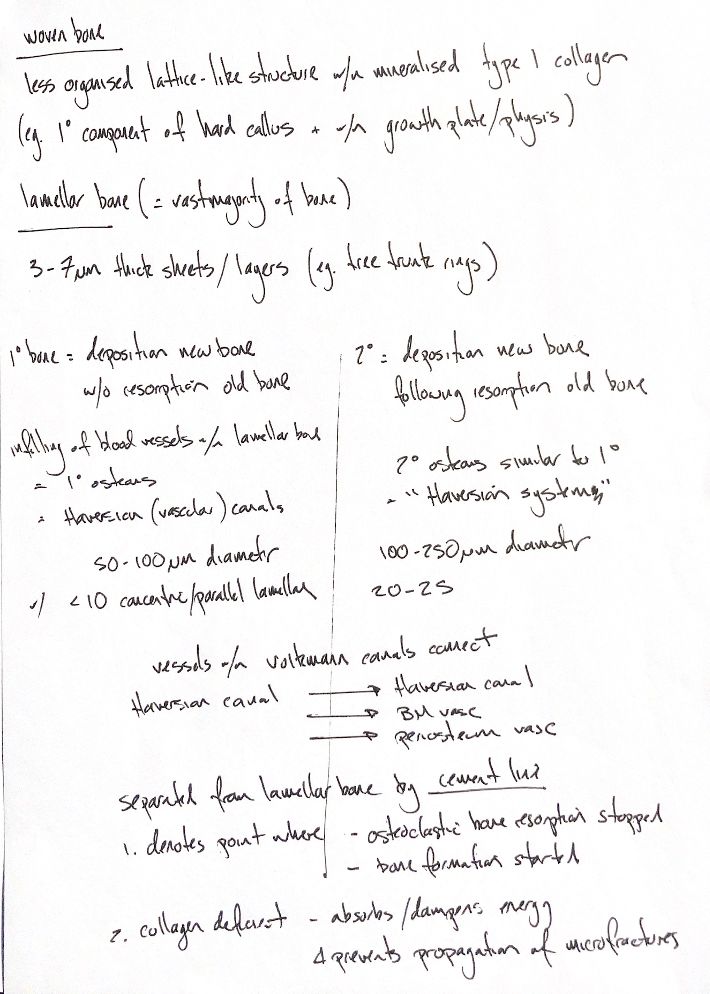
Woven bone forms quickly. Its mineralised type I collagen has a loose, less organised pattern. It appears in hard fracture callus and in new bone formed during physeal growth. Lamellar bone forms organised layers, like tree rings. Each lamella is about 3–7 µm thick, with variation by species and site.
Primary bone is deposited without first resorbing old bone. Bone can fill around an existing vessel to form a primary osteon. The reference dimensions are about 50–100 µm across, with fewer than 10 lamellae. That diameter belongs to the whole osteon, rather than its central canal.
Secondary bone replaces bone that has been resorbed. Its secondary osteon, or Haversian system, is larger: about 100–250 µm across, with 20–25 lamellae. Both types have a central Haversian canal carrying a neurovascular bundle. These dimensions vary by species and site.
Volkmann canals connect Haversian vessels to one another, to marrow vessels and to the periosteal network. A cement line marks the boundary where resorption stopped and new formation began. This collagen-deficient interface can absorb energy, deflect microcracks and damp repeated loading.
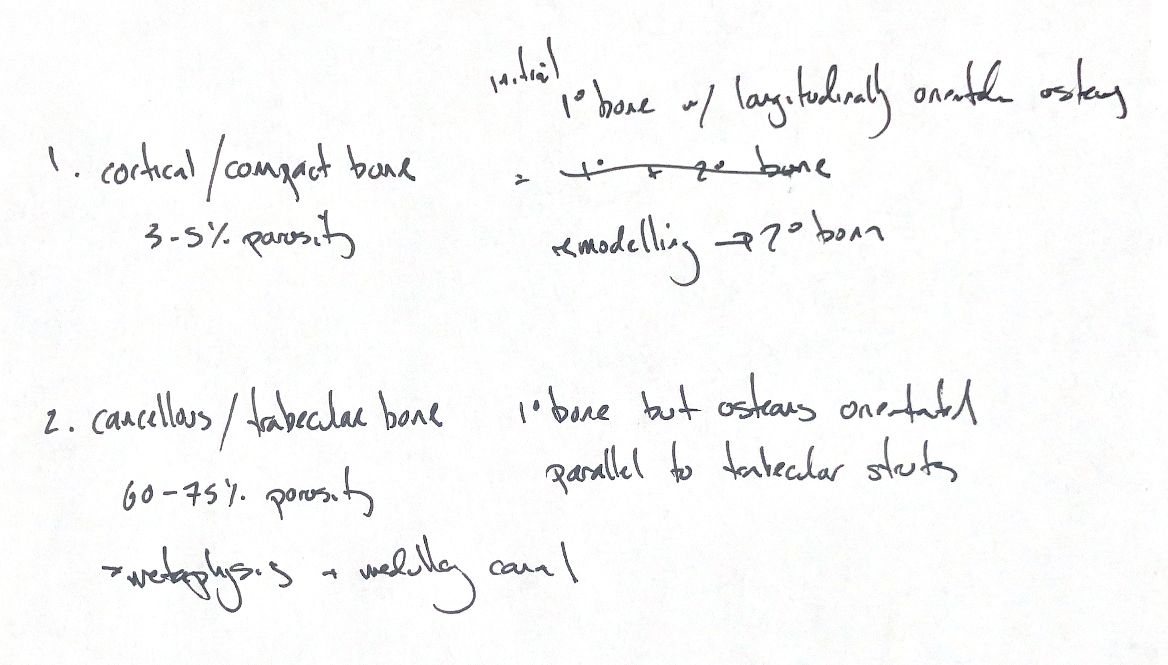
Cortical bone forms the dense shell. Primary lamellar bone is laid down longitudinally along the outer cortex; remodelling produces secondary osteons. Cancellous bone forms open trabecular struts, including in the metaphysis and around marrow spaces. Its lamellae lie parallel to the struts. The quoted porosity ranges are about 3–5% for cortex and 60–75% for cancellous bone, with species and site variation. Primary bone can be lamellar, and cancellous bone can also undergo remodelling.
References
hand-drawn ACVS Phase One notes; Johnston & Tobias, Veterinary Surgery: Small Animal, 2nd ed., Ch. 39, bone structural hierarchy. Descriptive ranges follow its cited Burr & Allen, Basic and Applied Bone Biology, 2014.