
Muscle contracture outcome recap
Read the draft explanation
Contracture shortens a muscle and makes it resist stretching. The outcome depends on which muscle is affected.
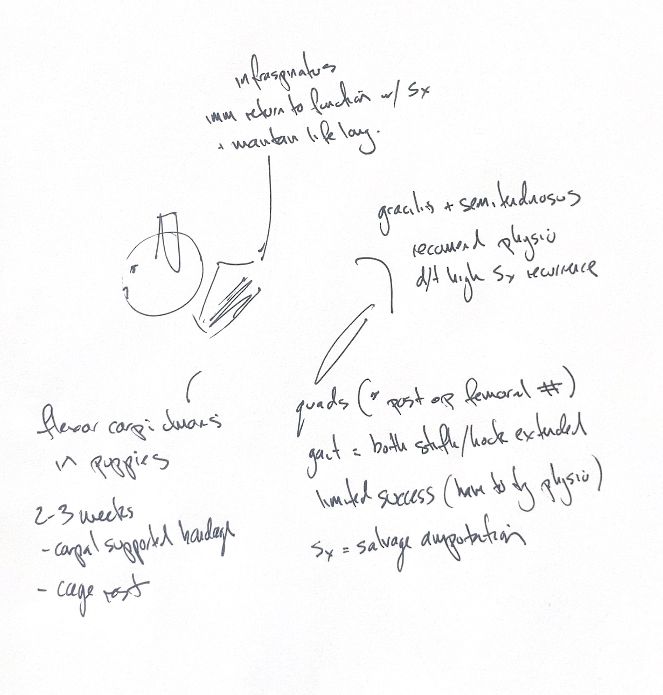
Infraspinatus contracture can respond well to surgery. Releasing the tendon of insertion and the surrounding fibrous adhesions can restore a normal gait immediately. That improvement can last long term.
Gracilis and semitendinosus contractures are different. Recurrence after surgery is common. Conservative care and physiotherapy focus on preserving useful function, with the abnormal gait often persisting.
Quadriceps contracture often follows a femoral fracture, especially in a growing dog. The stifle and hock stay extended and cannot flex normally. Early recognition and return of movement, including physiotherapy, offer the best chance of success. Once fibrosis, adhesions and joint stiffness are established, surgery has limited success. Severe persistent cases may need salvage amputation.
The puppy flexor carpi ulnaris problem is usually reversible. A tight tendon holds the carpus in flexion. Recovery often occurs within 2–3 weeks with reduced activity or cage rest. A short carpal support bandage can help when the deformity is marked. This timing refers to the reversible puppy syndrome.
References
Johnston & Tobias, Veterinary Surgery: Small Animal, 2nd ed., Ch. 70, muscle contractures and flexor carpi ulnaris sections. Vaughan 1992: https://doi.org/10.1111/j.1748-5827.1992.tb01178.x