
Normal versus lame kinetic gait traces
Read the draft explanation
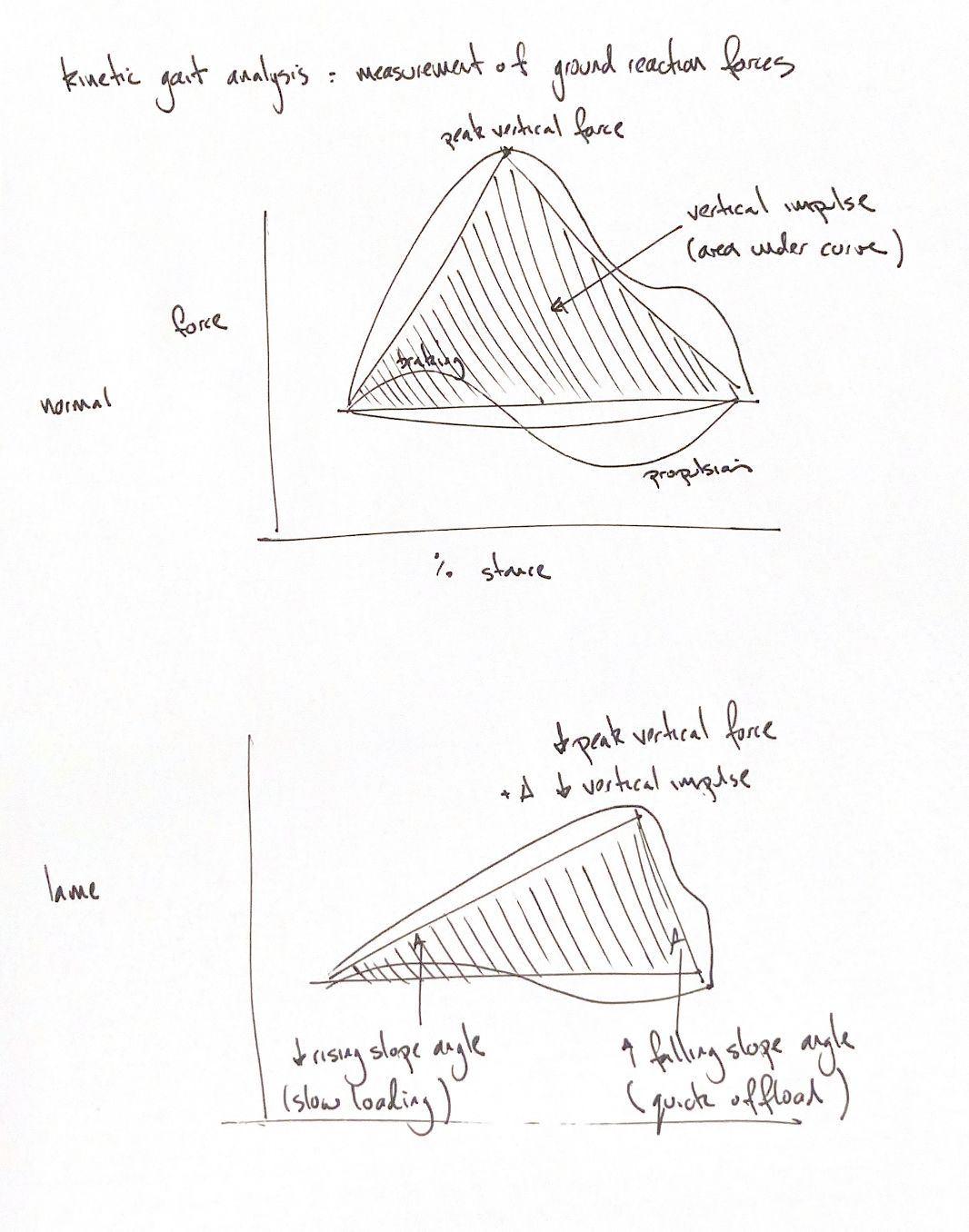
Kinetic gait analysis measures ground reaction forces. When a dog's paw pushes against the ground, the ground pushes back. The vertical force tells us how the limb accepts and supports load during stance.
Read the vertical curve in two ways. Peak vertical force is its highest point. Vertical impulse is the area under the force–time curve, so it reflects both force and contact time. A large brief force and a smaller sustained force can give different peaks and impulses.
A painful or lame limb usually carries less load. Peak vertical force and vertical impulse therefore tend to fall. The rising part of the curve becomes shallower as the dog loads the limb more cautiously. The falling part becomes steeper as the dog removes weight more quickly. “Increased falling slope” means a greater slope magnitude: the descent is steeper, even though its signed slope is negative.
The craniocaudal curve adds braking and propulsion. Braking occurs early in stance as the limb slows forward movement. Propulsion occurs later as the dog pushes off. With the sign convention used here, braking is positive and propulsion is negative.
These are schematic patterns. Curve shape changes with gait, speed and the limb being tested. Compare trials under matched conditions. The horizontal axis runs from 0 to 100% of stance to align the traces. Keep the actual stance duration when calculating impulse or loading and offloading rates; percent stance alone does not provide elapsed time.
References
hand-drawn ACVS Phase One study note; Johnston and Tobias, Veterinary Surgery: Small Animal, 2nd edition, Chapter 74, Kinetic Gait Analysis. Reduced vertical and craniocaudal forces in canine cruciate injury are also reported by Budsberg et al., American Journal of Veterinary Research, 1988;49:1522–1524, https://pubmed.ncbi.nlm.nih.gov/3223659/.