
Contrast media: iohexol and renal protection
Read the draft explanation
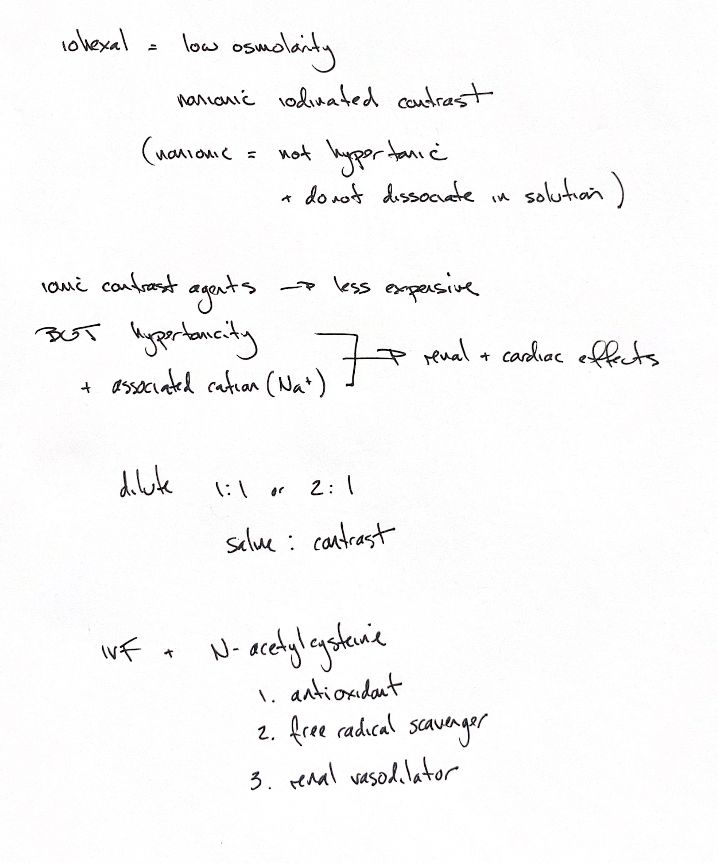
Iohexol is a low-osmolar, nonionic iodinated contrast agent used for interventional imaging. It stays as an intact molecule in solution. Traditional ionic agents dissociate into charged particles, often with sodium as the cation. They usually cost less, but their greater osmotic load and cation effects can be troublesome in patients with renal or cardiac disease.
Low-osmolar does not mean isotonic. Iohexol at 300 mg iodine/mL has an osmolality of 672 mOsm/kg water and is still hypertonic to plasma. Nonionic and isotonic describe different properties.
For intravascular angiography, saline:contrast mixtures of 1:1 or 2:1 are examples used to reduce the contrast concentration. State the starting iodine concentration as well as the ratio; the ratio alone does not tell you how much iodine the patient receives. These are procedure-specific examples, not a dilution rule for every contrast route.
Hydration supports renal perfusion. Correct dehydration and tailor IV fluids to the patient. Contrast-associated renal injury can involve vasoconstriction and direct tubular toxicity.
N-acetylcysteine has been proposed as an antioxidant, a free-radical scavenger and a renal vasodilator. Those mechanisms do not prove clinical protection. In the human PRESERVE angiography trial, oral NAC did not prevent contrast-associated AKI or improve the major renal outcome at 90 days. Keep that human result separate from canine evidence; NAC should not be presented as proven protection for a veterinary patient.
References
Johnston & Tobias, Veterinary Surgery: Small Animal, 2nd ed., Ch 23; GE/FDA Omnipaque prescribing information, physical properties; Weisbord et al., N Engl J Med 2018;378:603–614, doi:10.1056/NEJMoa1710933.