
Organ biopsy: liver, spleen, kidney and pancreas
Read the draft explanation
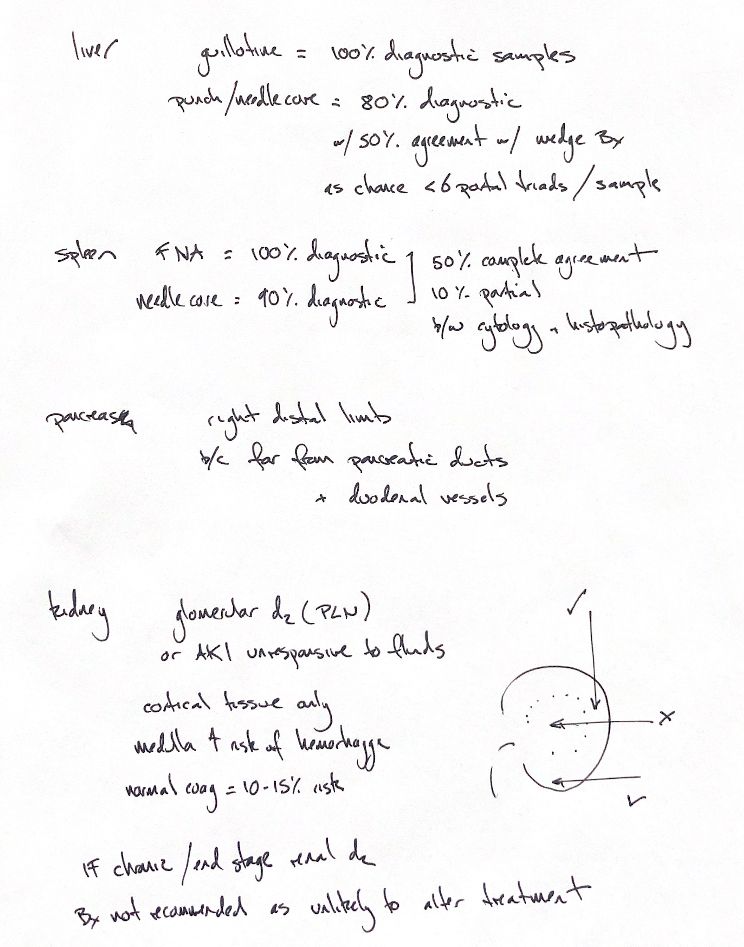
An adequate liver sample can still give a different diagnosis from a larger sample. The original 80% grouping for punch and needle needs separating: in 12 adult dogs, 40/48 needle samples were adequate (83.3%), while punch and guillotine samples were all adequate in that experiment. Some punch and needle samples had fewer than six portal triads. In a separate study of 124 dogs and cats, needle and wedge diagnoses matched in 59/124 (48%). Sample yield and diagnostic agreement are different outcomes.
The same distinction matters in the spleen. Of 40 dogs with paired tests, FNA was diagnostic in 40/40 and core biopsy in 35/40. Among those 35 paired diagnostic samples, the diagnoses agreed completely in 18/35 (51.4%) and partly in 3/35 (8.6%); 14/35 disagreed. The 90% core-yield cue rounds the observed 87.5% in this study.
Renal biopsy is useful when histology can change treatment, especially for glomerular disease/PLN or AKI that has not responded to appropriate treatment, including fluid therapy. Stay in the cortex: deeper medullary vessels raise bleeding risk. In a retrospective normal-coagulation subgroup, severe haemorrhage occurred in 10/97 dogs and 2/13 cats. It meant a PCV fall of more than 20% of the pre-biopsy value within 24 hours. The rounded 10–15% figures belong to that subgroup, not every patient. Chronic/end-stage renal disease is generally a poor indication when the result will not change treatment.
For diffuse pancreatic disease, sample the distal right limb, farther from the major pancreatic ducts and duodenal vasculature. Inspect focal lesions separately. Punch forceps cut; cup forceps tend to tear.
References
Johnston & Tobias, Veterinary Surgery: Small Animal, 2nd ed., Ch 20; Vasanjee et al., Vet Surg 2006;35:86–93; Cole et al., JAVMA 2002;220:1483–1490; Watson et al., Vet Radiol Ultrasound 2011;52:317–322; Vaden et al., JVIM 2005;19:794–801.