
General and skin/SQ biopsy technique
Read the draft explanation
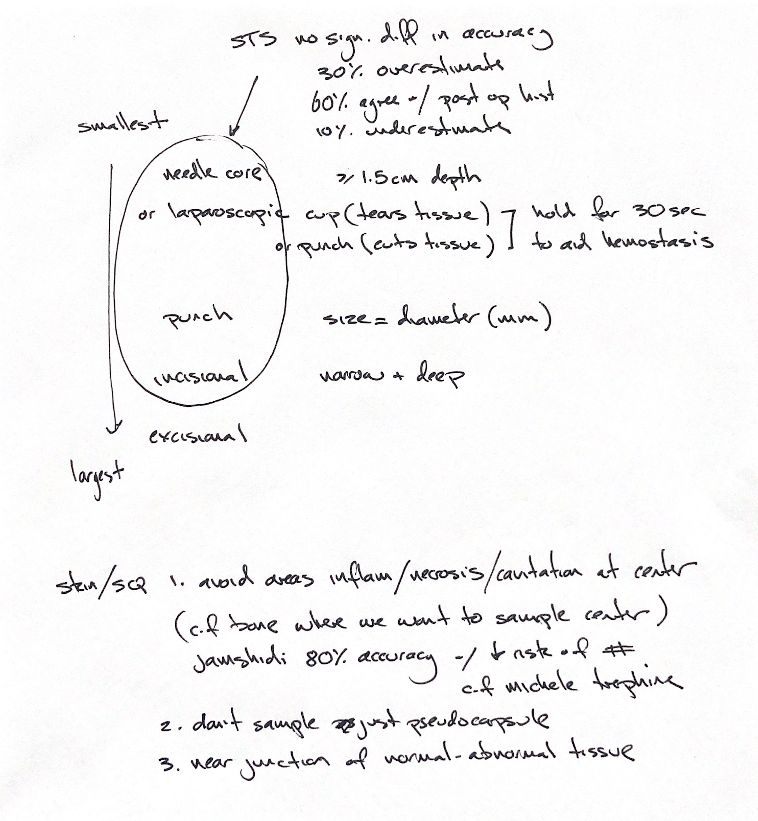
Biopsy size and biopsy site both matter. Needle-core samples are small. Many cutting devices need at least 1.5 cm of tissue depth to place the full sample notch within the target. Cup forceps tend to tear; punch forceps cut. For laparoscopic liver cup biopsy and pancreatic punch biopsy, hold the tissue for 30 seconds to help haemostasis before removing it. A skin punch is sized by its diameter in millimetres. An incisional sample should be narrow and deep. Excisional biopsy removes the whole lesion, so plan it with definitive treatment in mind.
For skin/SQ masses, target viable tumour near the normal–abnormal junction. Avoid central inflammation, necrosis and cavitation, and make sure you pass through any pseudocapsule into the actual tumour. Keep the tract short and place it where it can be removed at definitive surgery. Revisit the Chapter 01 oncology principles before choosing the final margins.
Bone is different: sample the centre of the radiographic lesion, because the edge may contain reactive bone. Jamshidi sampling leaves a smaller cortical defect than a Michele trephine and carries less fracture risk. In 62 bone lesions from 59 small animals, Jamshidi biopsy identified the specific lesion type in 51/62, or 82.3%—the more precise version of the rounded 80% cue.
A diagnosis does not guarantee the grade is right. In 68 dogs with STS, pretreatment grade matched definitive excision in 59%. Undergrading was more common than overgrading: 29% versus 12%, not the other way round. Needle-core, punch and wedge showed no significant difference in that study. Small samples can miss higher-grade areas, so submit the final excision for histology.
References
Johnston & Tobias, Veterinary Surgery: Small Animal, 2nd ed., Ch 20; Perry et al., Vet Comp Oncol 2014, doi:10.1111/j.1476-5829.2012.00333.x; Powers et al., JAVMA 1988;193:205–210 (PMID3165373).