
Mesh interface failure and edge preparation
Read the draft explanation
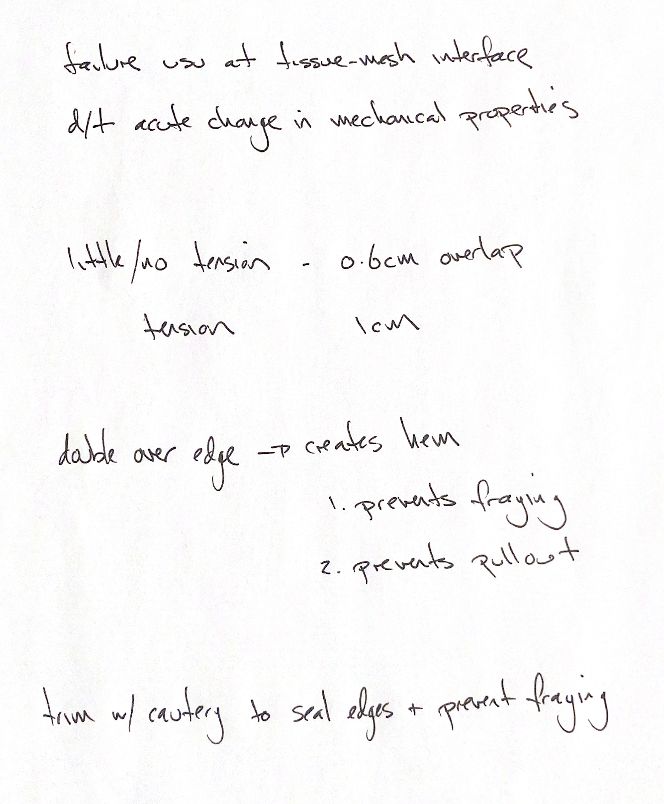
Mesh often fails at the tissue–mesh interface. This junction brings materials with different mechanical properties together, so the attachment must spread load across intact tissue.
Approximate overlap recommendations are 0.6 cm when there is little or no tension, and 1 cm under tension. Overlap means the mesh extending beyond the defect onto native tissue. It is not the distance from the suture to the mesh edge. Choose the overlap and fixation for the defect, tissue and mesh material.
Fold the mesh edge over to form a hem. The doubled margin helps limit fraying and suture pull-out. A horizontal mattress pattern can engage more than one filament and may be combined with a simple continuous pattern where extra support is needed.
Electrosurgical trimming can seal suitable synthetic mesh edges and limit fraying. The edge technique depends on the material. Trim the mesh to fit and use the smallest amount that completes the repair.
References
Johnston & Tobias, Veterinary Surgery: Small Animal, 2nd ed., ch. 16, surgical mesh technique. Trostle & Rosin, Selection of prosthetic mesh implants, Compend Contin Educ Pract Vet 1994;16:1147–1154.