
Mesh architecture and biologic incorporation
Read the draft explanation
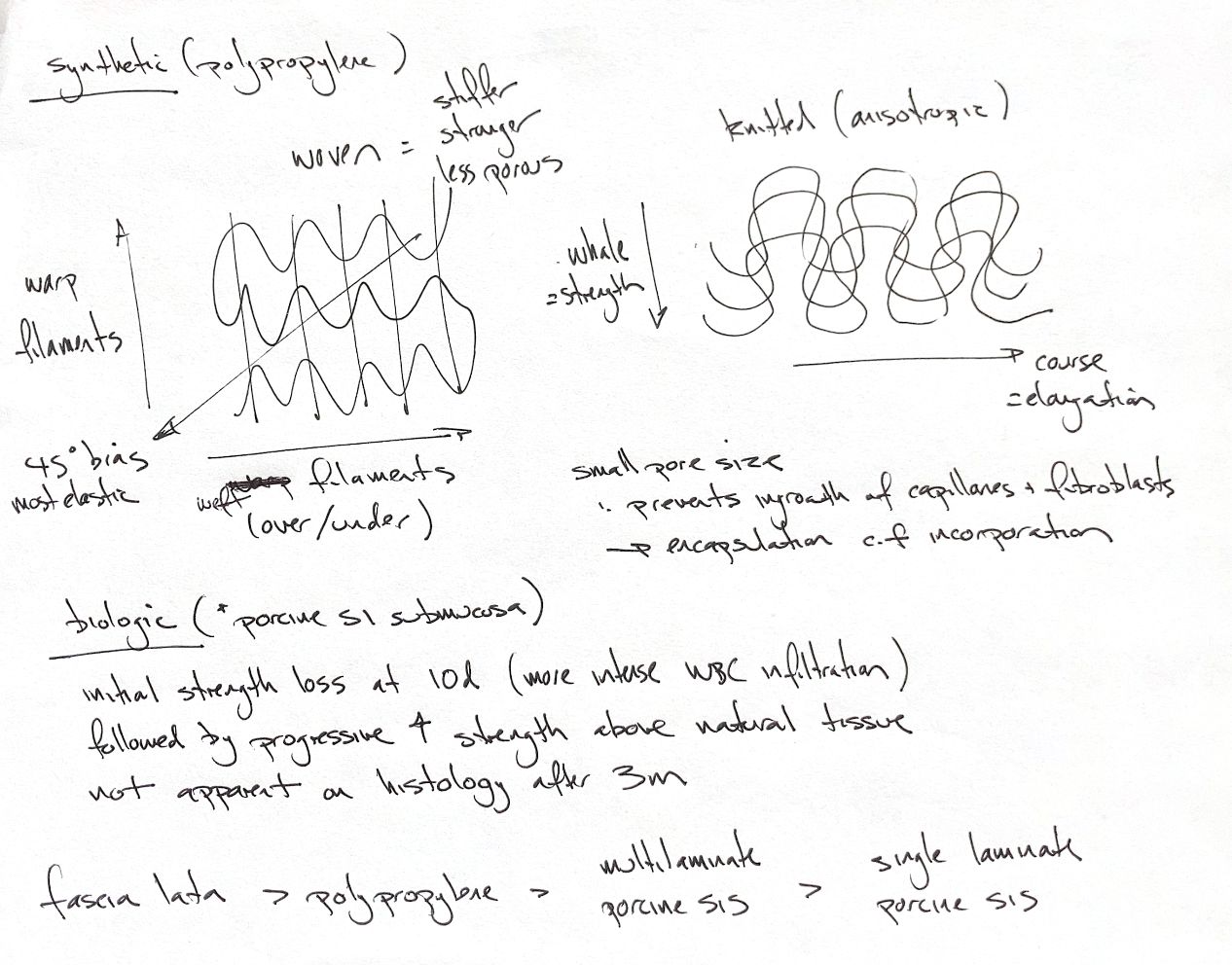
Mesh structure changes how it carries load. Woven mesh has warp filaments crossed by weft filaments. It is most elastic along the 45° bias. Compared with knitted mesh, it tends to be stiffer, stronger and less porous. Knitted loops give different properties in different directions. In patterns with clear axes, the wale carries more strength and the course allows more elongation.
Very small pores can block capillary and fibroblast ingrowth. The implant becomes encapsulated rather than incorporated into host tissue.
Porcine small intestinal submucosa, or SIS, acts as a scaffold for host tissue. In a canine body-wall study using eight-layer SIS, ball-burst load fell to its low point at 10 days, then rose above native body-wall strength during later remodelling. The study used 40 dogs, with five at each time point. This was a mechanical test of the repair site.
Dog and rat body-wall studies found greater early leukocyte infiltration with SIS than with polypropylene, PGA or bovine pericardium. By 3 months, the original SIS was no longer apparent on histology and host tissue had replaced it. The early inflammatory response and the strength timeline came from separate experiments.
The material ranking comes from bench testing, not a clinical success ranking. Ten samples per material and test underwent suture pullout, tension or push-through testing. The broad order was frozen canine fascia lata > polypropylene > four-layer porcine SIS > single-layer SIS, with some exceptions. Polypropylene tolerated greater tensile load when its longitudinal cords ran along the force. Single-layer SIS performed poorly in high-strain testing.
References
Johnston & Tobias, Veterinary Surgery: Small Animal, 2nd ed., ch. 16, Figs. 16.7–16.8. Arnold et al. 2009, doi:10.1111/j.1532-950X.2009.00577.x. Badylak et al. 2001, doi:10.1006/jsre.2001.6176; 2002, doi:10.1006/jsre.2001.6349.