
Cyanoacrylate bonding and derivative tradeoffs
Read the draft explanation
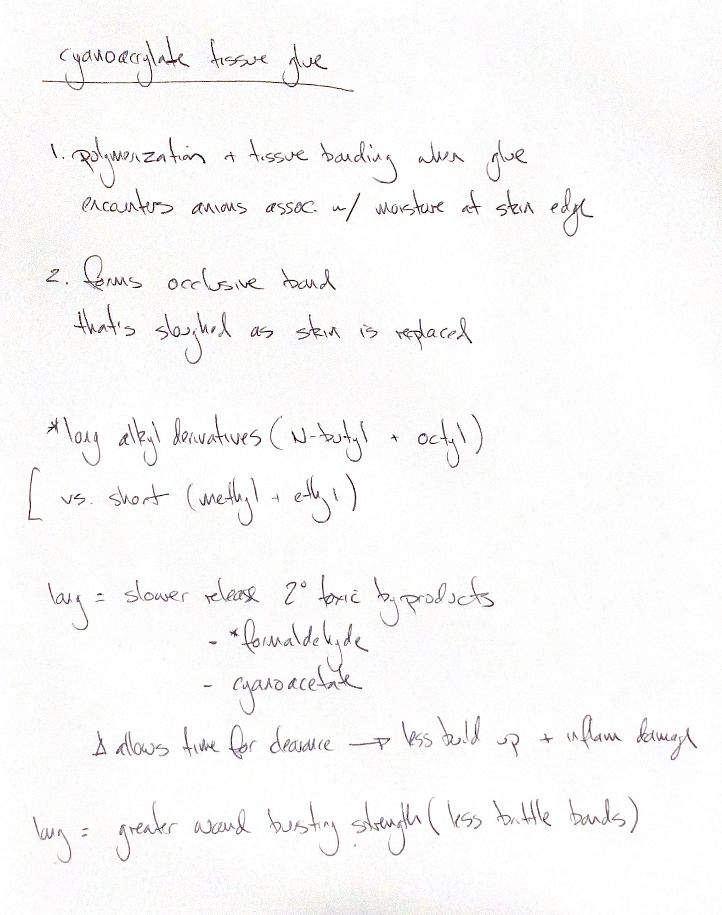
Cyanoacrylate starts as liquid monomers. Anions at the moist skin edge trigger polymerisation and tissue bonding. The monomers join into a solid film that bridges the wound and bonds to surface cells. It forms an occlusive seal, then sloughs as those cells die and are replaced.
The alkyl side chain changes how the adhesive behaves. Methyl and ethyl derivatives have short chains. Their bonds can be strong but brittle, so a topical bridge may crack under load. The longer n-butyl and octyl derivatives form less brittle bonds and can give greater wound bursting strength. The exact result also depends on the formulation and how it is applied.
Polymerisation builds the film. Later polymer degradation releases formaldehyde and cyanoacetate. Faster release can let these toxic products build up locally. Longer-chain alkyl derivatives generally release them more slowly, giving tissue more time to clear them and reducing tissue damage. This chain-length effect is supported by laboratory degradation and cell-culture work; exposure and application site also matter.
For skin closure, hold the edges precisely together with little or no tension. The glue belongs over the surface as a bridge. Glue trapped inside the wound can drive a foreign-body reaction and local inflammation. A more flexible adhesive still needs proper tissue apposition and tension control.
References
Johnston & Tobias, Veterinary Surgery: Small Animal, 2nd ed., ch. 16. Park et al. 2003, doi:10.1002/app.12452. Singer et al. 2008, doi:10.1016/j.ajem.2007.05.015.