
Sutures in urine
Read the draft explanation
Urine can change suture strength within days. The organism and the material both matter.
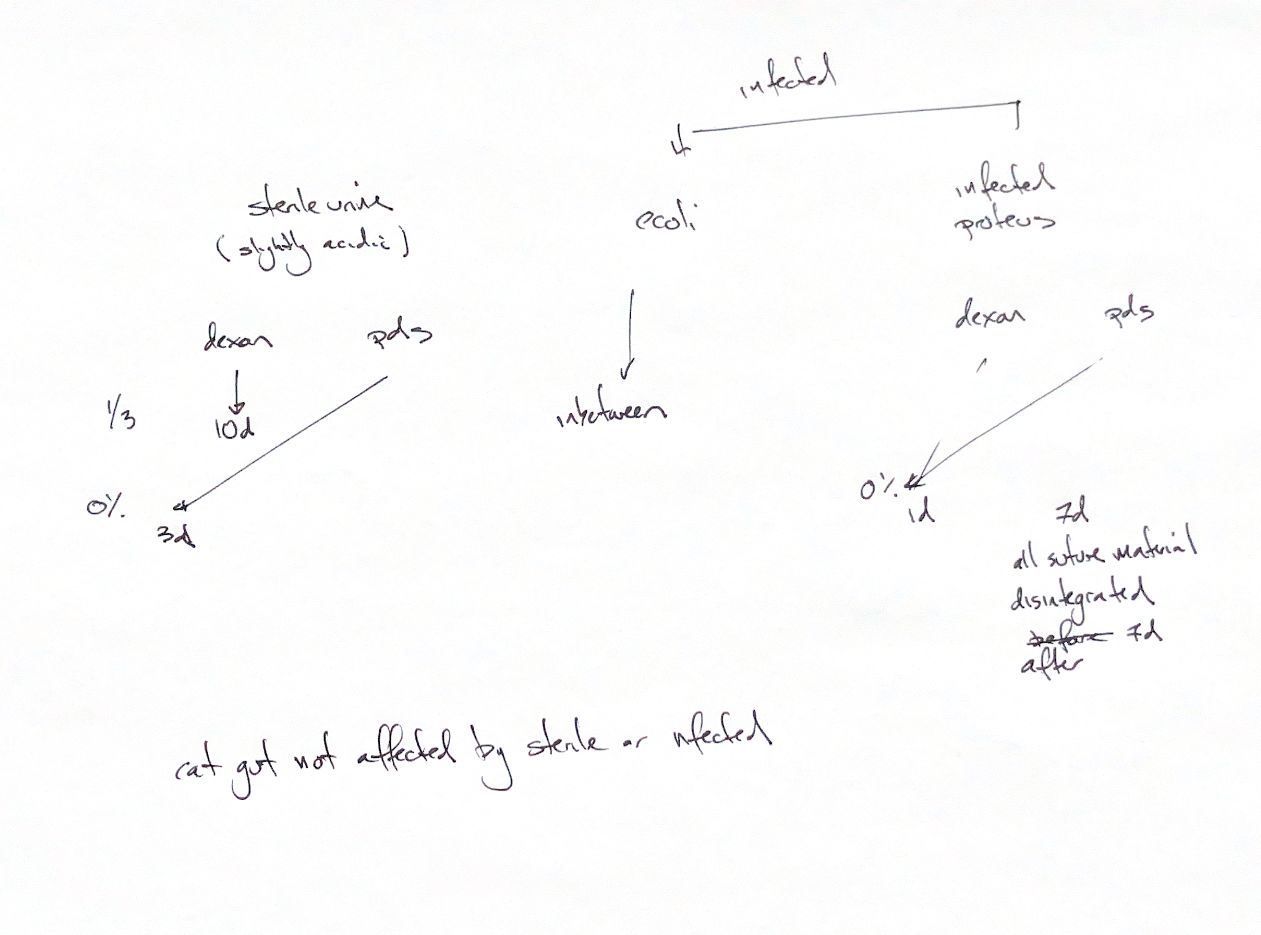
In the 1987 immersion study, PDS lost all strength by day 3 in sterile urine. Dexon lost 64% by day 10, leaving about one-third. Chromic gut maintained its strength through day 10.
E. coli did not sit neatly between sterile urine and Proteus. PDS reached zero strength by day 6, while Dexon lost 71% and chromic gut lost 8% by day 10. In Proteus-infected urine, PDS and Dexon reached zero by day 1. Chromic gut lost 5.8% by day 10. Its resistance was relative; it was not completely unaffected.
The 2004 study used urine pooled from six healthy dogs, five media and ten strands of each material per medium. PDS, Monocryl, Maxon and Biosyn all disintegrated BEFORE day 7 in P. mirabilis-inoculated urine. That finding covers these four materials, not every suture. All four lost strength over time in every medium. PDS and Maxon performed better in sterile neutral and E. coli urine; PDS retained the greatest tensile strength across the study. Monocryl may lose too much strength by the 14–21-day bladder-healing window.
These are in vitro immersion results. Limit contact between a hydrolytically degraded suture and Proteus-containing urine during bladder surgery.
References
el-Mahrouky et al., J Urol 1987;138:913–915 (PMID 2821292); Greenberg et al., Am J Vet Res 2004;65:847–853, doi:10.2460/ajvr.2004.65.847; Johnston & Tobias, Veterinary Surgery: Small Animal, 2nd ed., Ch. 16.