
Suture absorption and pH
Read the draft explanation
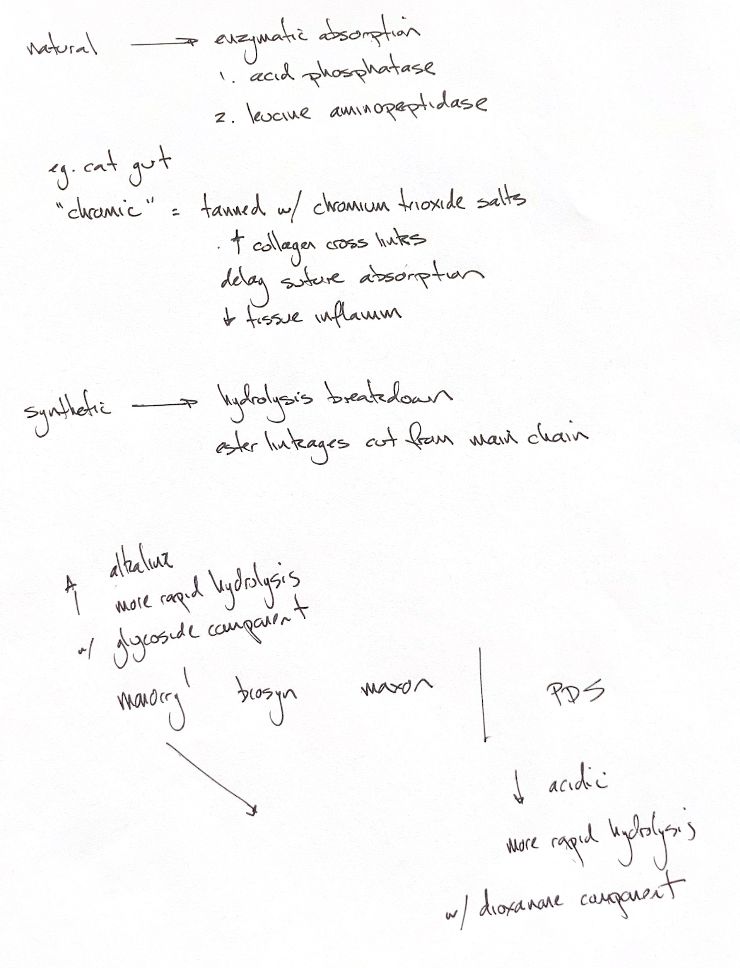
Natural and synthetic absorbable sutures break down by different routes.
Catgut relies on enzymes. Cellular proteases and collagenases break down its collagen; acid phosphatase and leucine aminopeptidase play key roles. Chromic gut is tanned with chromium trioxide salts. The treatment adds collagen cross-links, slows absorption and reduces tissue inflammation compared with plain gut.
Synthetic absorbable sutures lose strength as water cleaves ester linkages at random along the polymer main chain.
pH changes that process. Sutures with a glycolide component, including Monocryl, Biosyn and Maxon, degrade faster in alkaline media. PDS II loses strength rapidly in strongly acidic media. In the cited laboratory study, the acid condition was pH 1.0; the other buffers were pH 7.4, 8.5 and 10.5, all at 37°C. This strong-acid result does not mean every mildly acidic fluid has the same effect.
References
Johnston & Tobias, Veterinary Surgery: Small Animal, 2nd ed., Ch. 16; Tomihata et al., J Biomed Mater Res 2001;58:511–518, doi:10.1002/jbm.1048.