
Knot mechanics, throws and pattern response
Read the draft explanation
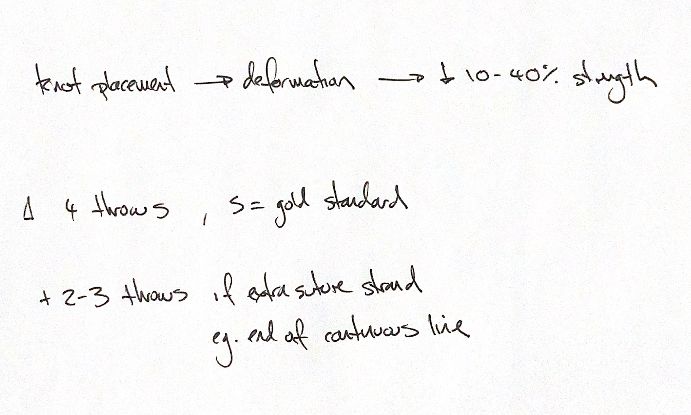
A knot bends and deforms the strand. That deformation commonly reduces suture strength by 10–40%.
The general teaching rule is at least four throws, with a five-throw square knot as the conventional reference. A continuous ending knot ties one free strand to a loop: three strands in total. It needs two to three extra throws.
The classic PDS test used 2-0 suture, snug square knots and canine serum at 37°C for 24 hours. Four throws secured a standalone knot. Starting a continuous line needed one more, giving five; ending it needed two to three more, giving six to seven. The first throw counted. The 1500 g value describes the laboratory tying condition.
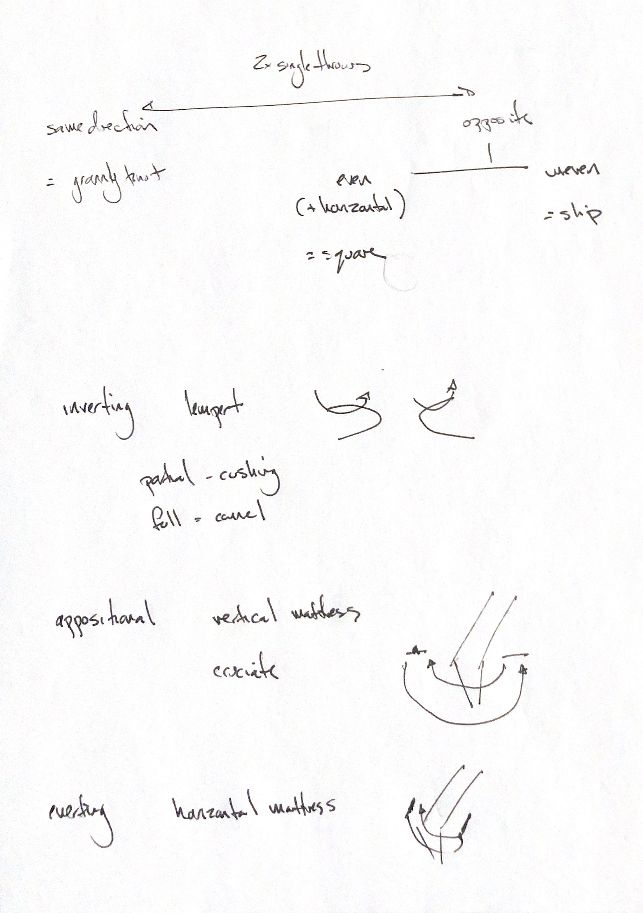
Direction and tension both matter. Two identical simple throws make a granny knot. Reverse successive throws and pull both ends evenly in the plane of the knot to make a square knot. Unequal strand tension can produce a sliding half-hitch. Cover a deliberate slip knot with a square knot.
Pattern geometry changes the wound edges. Lembert, Cushing and Connell invert them. Lembert and Cushing take partial-thickness bites; Connell enters the lumen. Vertical mattress and cruciate usually appose the edges. Horizontal mattress is everting. Purchase and tension still determine the final edge response.
References
Johnston & Tobias, Veterinary Surgery: Small Animal, 2nd ed., Ch. 16–17; Rosin & Robinson, Vet Surg 1989;18:269–273, doi:10.1111/j.1532-950X.1989.tb01083.x; Annunziata et al., J Emerg Med 1997;15:351–356, doi:10.1016/S0736-4679(97)00021-8.