
Suture strength over time
Read the draft explanation
Suture strength falls before the material disappears. Match the support window to the tissue and the local environment.
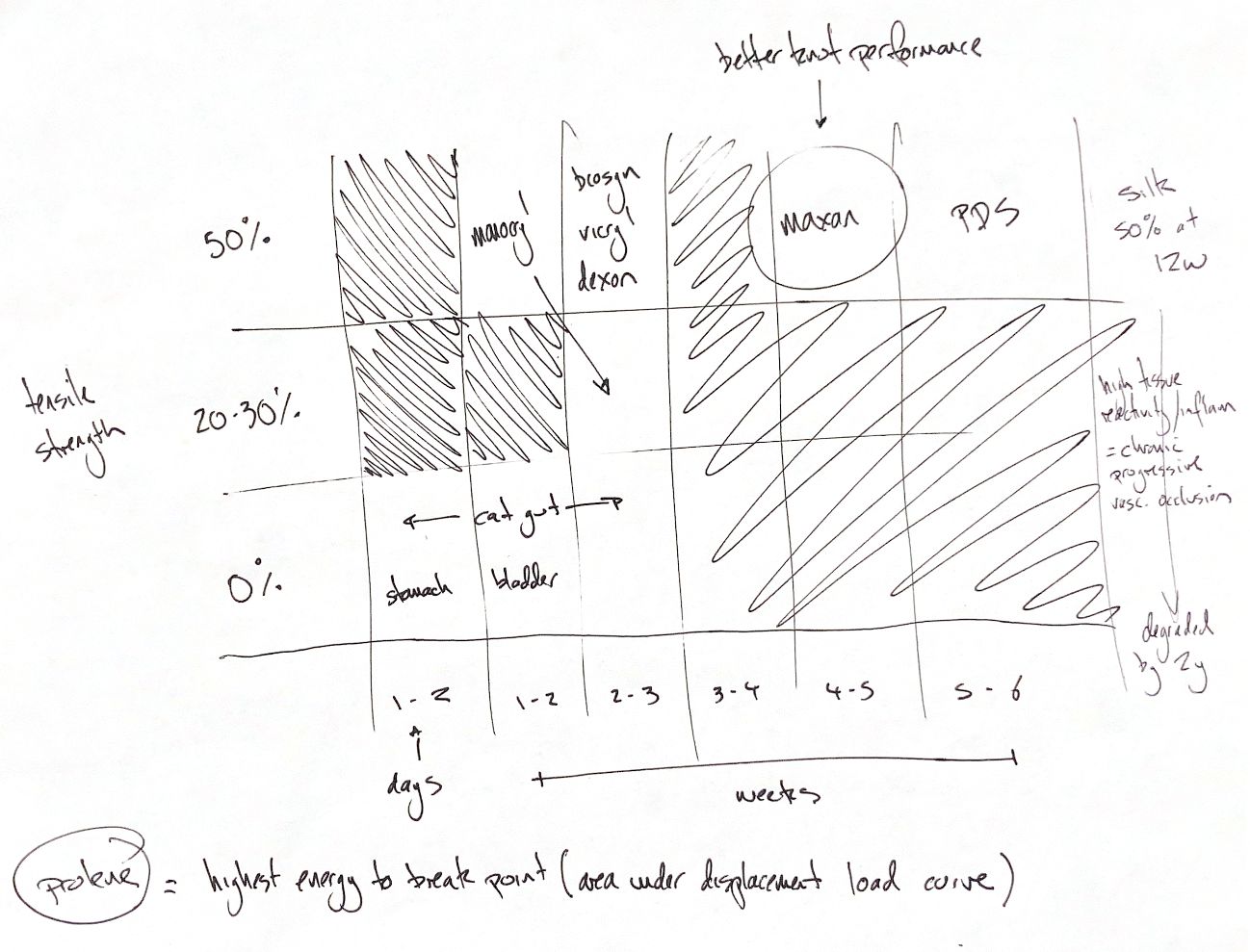
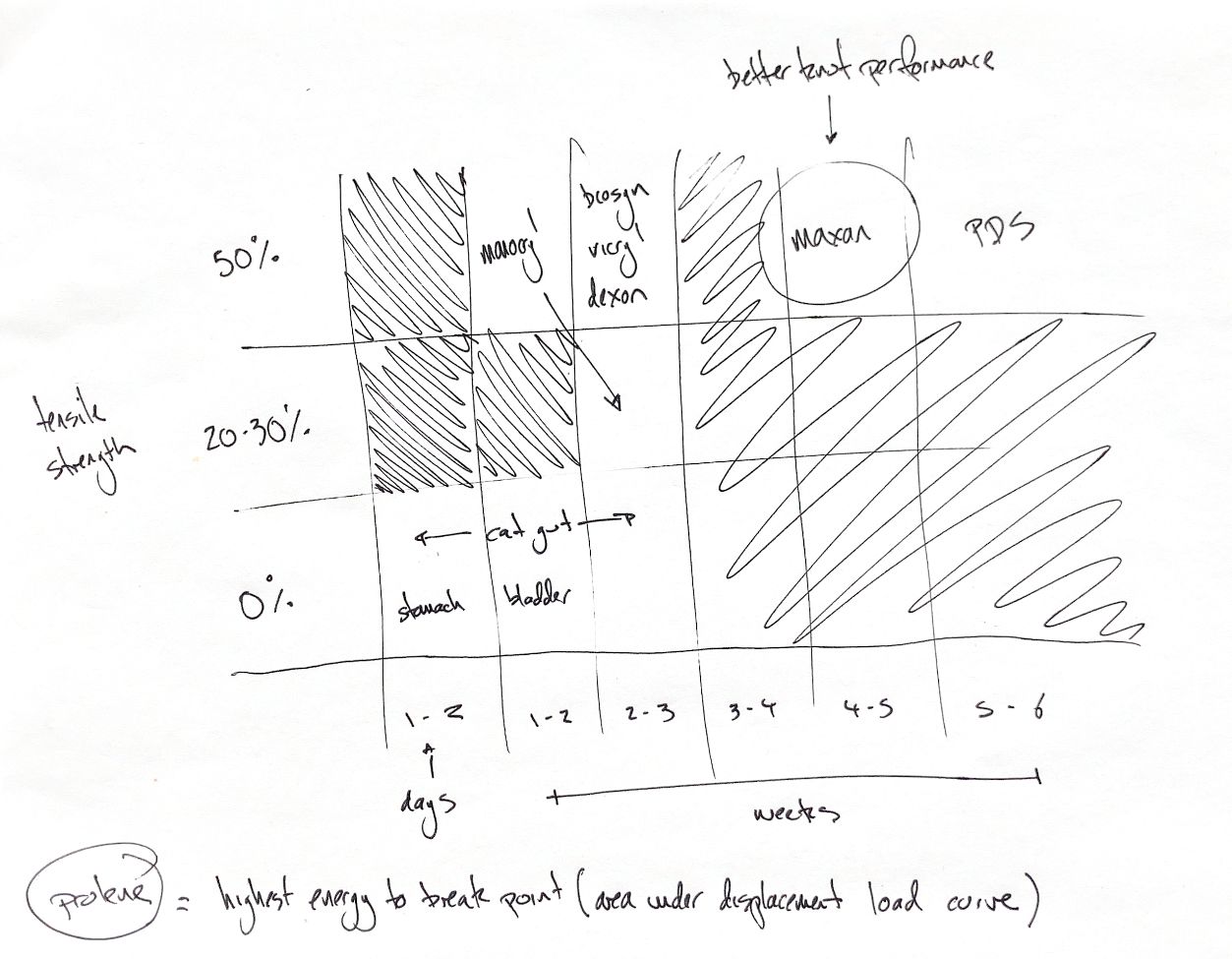
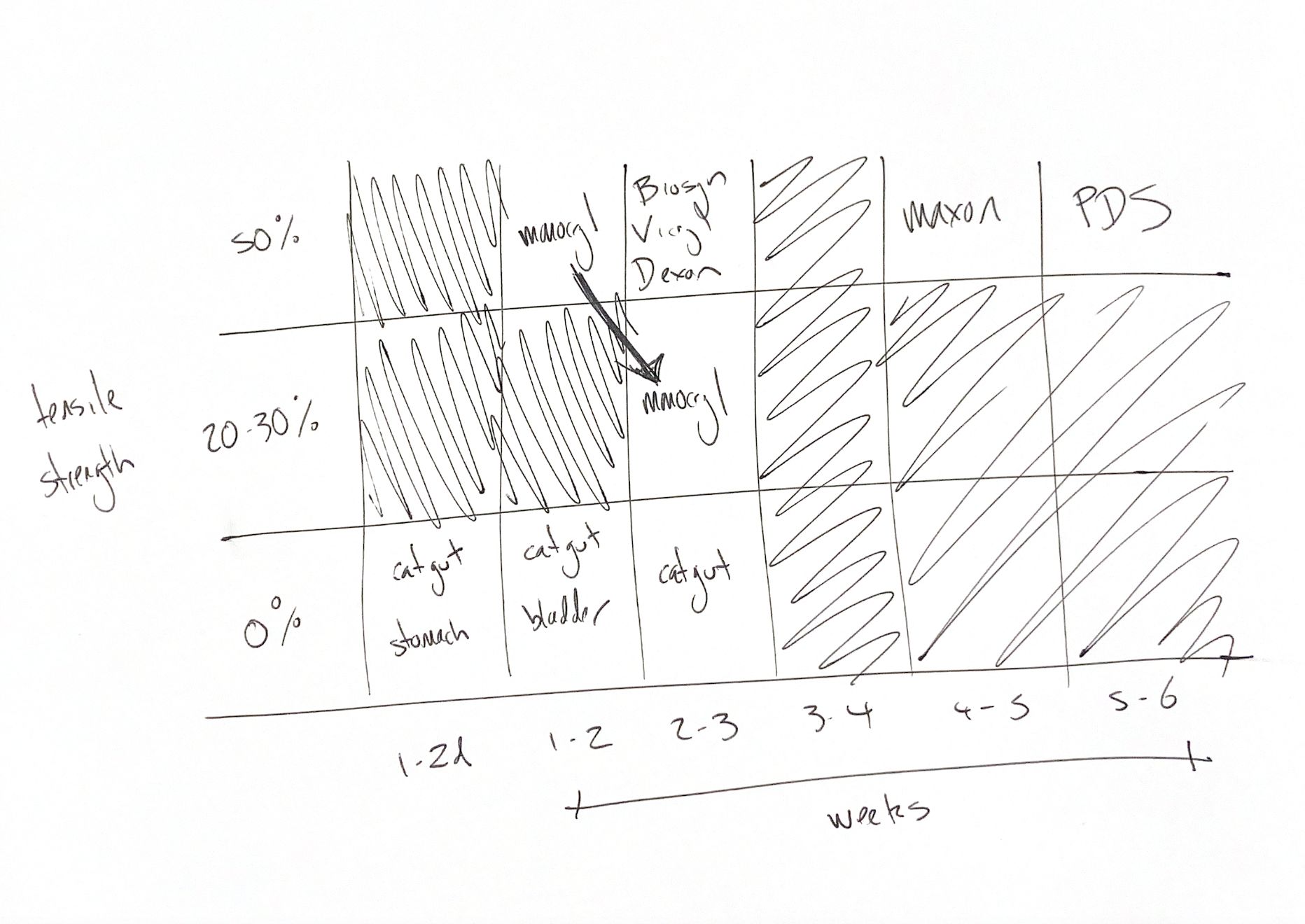
In rat subcutis, Monocryl retained about 50% of its starting strength at 1 week. It was already down to 20–30% at 2 weeks. Biosyn, Vicryl and Dexon reach roughly half strength at 2–3 weeks. Maxon reaches that point at 4–5 weeks; PDS II at about 5–6 weeks. These are approximate guides. Size, formulation and local conditions change the curve.
Catgut loses strength quickly and unevenly. The general guide is no tensile strength by 2–3 weeks. In the reported canine stomach work, plain gut lost all strength in about 12 hours and chromic gut in 24 hours. In bladder surgery, catgut can lose 90–100% within 7 days.
Silk keeps about half its initial strength at 12 weeks: the cited value is 56%, rather than exactly 50%. It degrades over about 2 years. Its strong tissue reaction may help gradual vascular narrowing after partial ligation, but a canine femoral-vein model showed no significant progressive narrowing at 6 weeks.
Maxon had the highest loop-holding capacity among five absorbable sutures in a 3-0 laboratory comparison. Prolene led a different comparison for energy to break. That energy is the area under the load–displacement curve, measured in N·mm. A strong strand and a secure knot are different properties.
References
Johnston & Tobias, Veterinary Surgery: Small Animal, 2nd ed., Ch. 16, Tables 16.2–16.3; Bezwada et al., Biomaterials 1995;16:1141–1148; Trimbos et al., Eur J Surg 1995;161:319–322 (PMID 7662774); Kim et al., J Mater Sci Mater Med 2007;18:2363–2369, doi:10.1007/s10856-007-3114-6.