
Suture mechanical vocabulary
Read the draft explanation
What is capillarity or wicking? How do creep, elasticity and memory differ? What separates knot strength from knot pull-out strength?
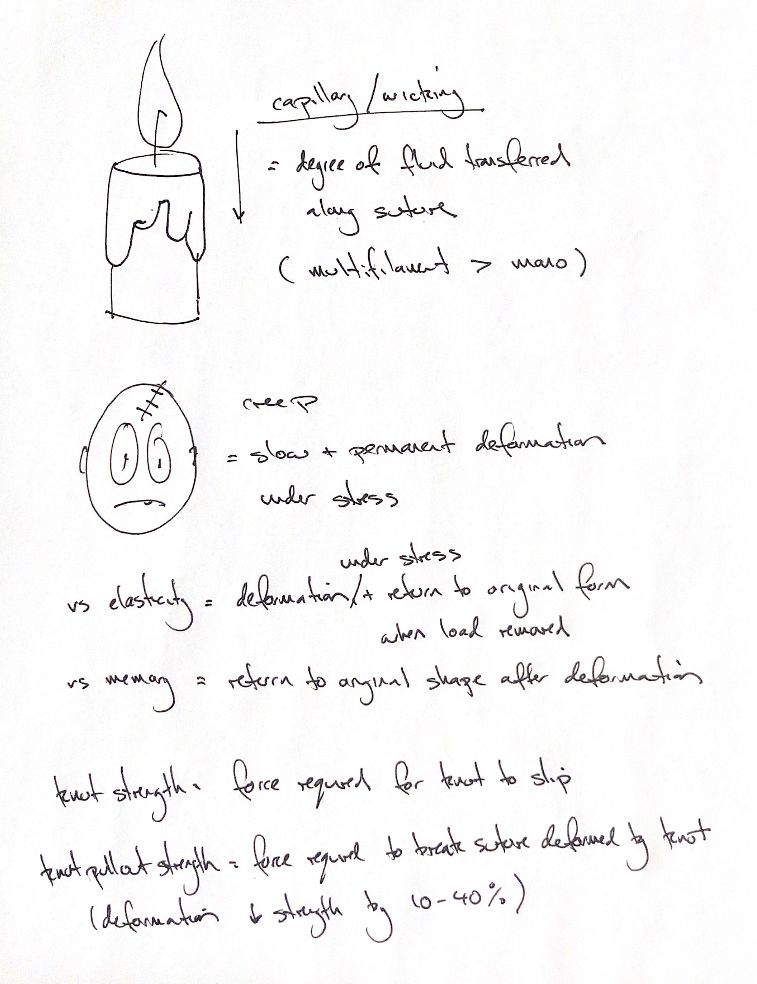
Capillarity describes how absorbed fluid travels along a suture. Multifilament sutures generally wick more than monofilaments. Fluid absorption means taking fluid up; capillarity means moving it along.
Creep is slow, permanent deformation while a constant load is held. The strand remains longer after the load is removed. Elasticity lets a strand deform under load and return when the load comes off. Memory is the tendency to regain an earlier shape, such as the coil left by its package.
Knot strength is the force needed to make a knot slip. The strand may remain intact while the knot loosens. Knot pull-out strength is the load needed to break a strand that has been deformed by a knot. Here the endpoint is rupture. This is a knotted-suture tensile test, not a test of pulling a suture loop out of tissue.
Knot placement can reduce strength by about 10–40% compared with the unknotted strand. The material and knot affect the loss. Keep the failure mode clear when comparing studies: a knot that slips and a strand that breaks have failed in different ways.
References
Johnston & Tobias, Veterinary Surgery: Small Animal, 2nd ed., ch. 16, suture terminology (citing Lai, Becker & Edlich, “Sutures and needles,” 2009).