
Forceps: grip serrations and clamp action
Read the draft explanation
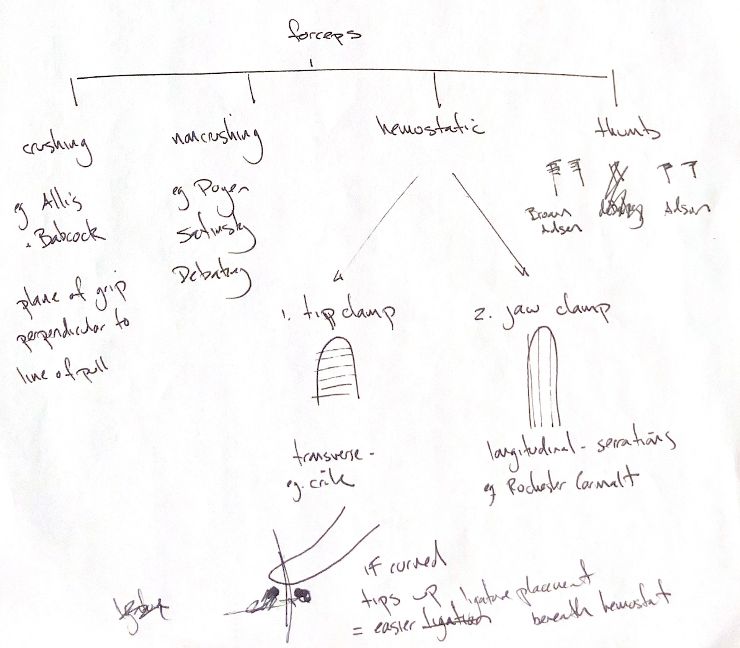
Choose forceps by the tissue and the way the jaws grip it. Allis and Babcock can crush tissue. Their grip plane lies across the direction of pull. Use crushing forceps on tissue being removed. Doyen, Satinsky and DeBakey belong to the noncrushing group. Doyen occludes bowel; Satinsky can partly occlude a large vessel. Longer Doyen application can still injure bowel.
For haemostats, match the serrations to the bite. Transverse serrations, as on Crile forceps, suit tip clamping of a small tissue bite. Longitudinal serrations, as on Rochester-Carmalt forceps, suit jaw clamping of a larger bundle. Carmalt also has cross-hatching at its tips.
Thumb forceps include Brown-Adson, DeBakey and Adson. Brown-Adson has fine teeth in two parallel rows. DeBakey has longitudinal ribs. Toothed Adson has a fine 1 × 2 tip pattern.
When ligating a bleeding point, place curved haemostat tips upward. This leaves space to pass the ligature around the vessel beneath the clamp. Use the least pressure and shortest clamp time that secure the tissue.
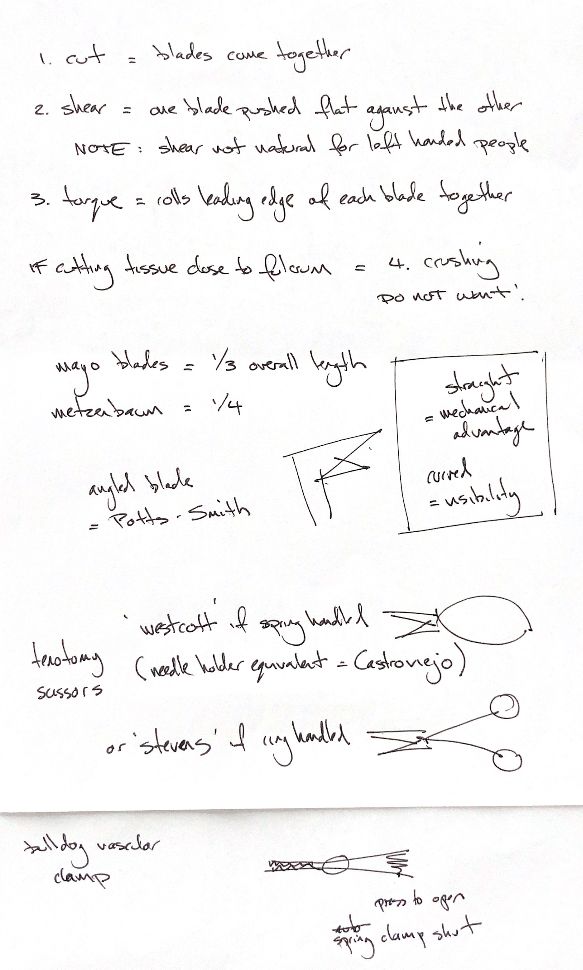
A bulldog vascular clamp works by spring action. Squeeze its short handles to open the jaws. Release them and the spring holds the jaws shut.
References
Johnston & Tobias, Veterinary Surgery: Small Animal, 2nd ed., ch. 12, Tissue Forceps and Thumb Forceps; ch. 17, Forceps. Teleflex Pilling bulldog clamp catalogue.