
Scissors: forces blades and handles
Read the draft explanation
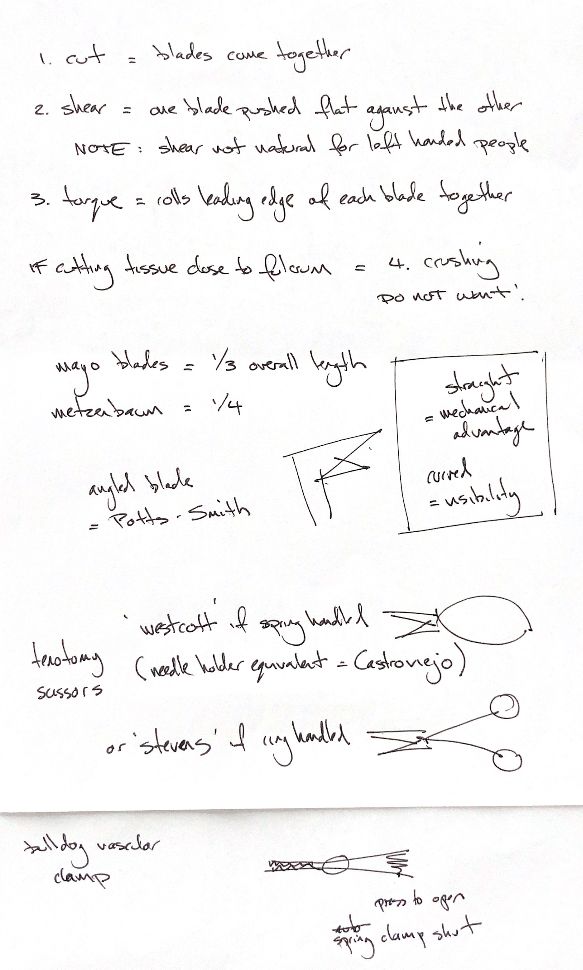
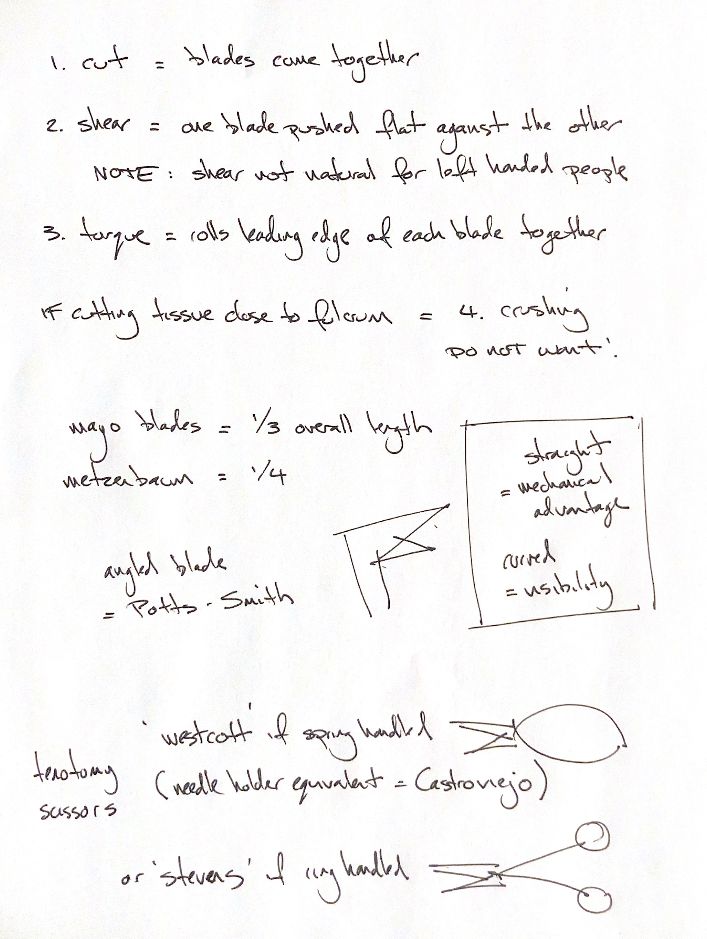
A scissor cut combines three forces. Closing brings the blades together. Shearing presses one blade flat against the other. Torque rolls the leading edges inward until they touch. Crushing is the fourth memory cue, but it is an unwanted effect. Tissue caught close to the fulcrum suffers more crush injury and can leave a jagged incision.
Standard scissors favour the right hand because its grip naturally creates the shearing force. A left-handed surgeon must learn that action with practice. Mayo scissors have thicker blades, about one-third of the total instrument length, for denser tissue such as fascia. Metzenbaum blades are thin and delicate, about one-quarter of the total length.
Straight blades give greater mechanical advantage. Curved blades improve visibility and manoeuvrability, especially deeper in a wound. Potts-Smith scissors have angled blades for cardiovascular work.
For ophthalmic tenotomy scissors, remember the handles: Westcott uses a spring handle; Stevens uses finger rings. Castroviejo is the related spring-handle cue for a needle holder. Its gripping jaws hold a needle rather than cut like scissor blades. Bulldog vascular clamps reverse the spring cue: squeeze to open, then let the spring close the jaws.
References
Johnston & Tobias, Veterinary Surgery: Small Animal, 2nd ed., ch. 12, Scissors and Needle Holders; ch. 17, Scissors. Instrument patterns also checked against Storz and Teleflex manufacturer catalogues.