
Bone instruments: bevel and bite mechanics
Read the draft explanation
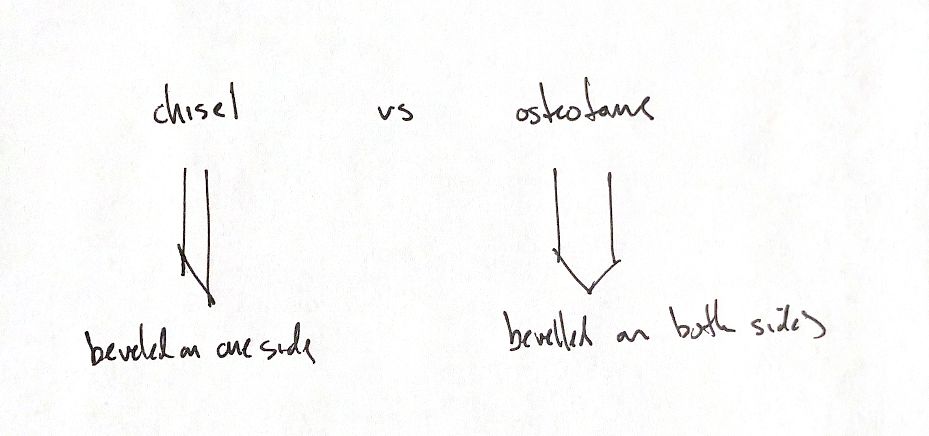
The bevel is the quick way to tell a chisel from an osteotome. A chisel has one bevel. An osteotome has two, meeting at the tip. Both are commonly used with a mallet to cut bone.
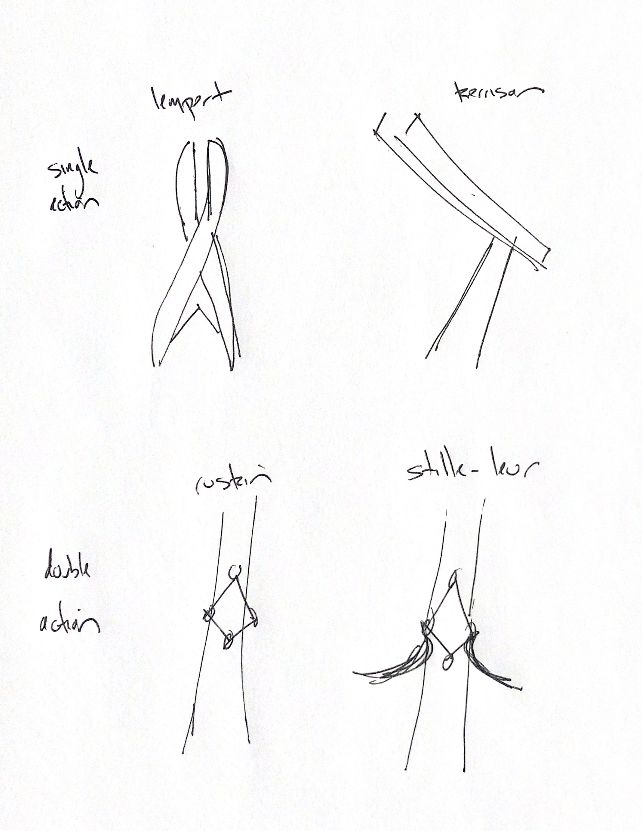
For rongeurs, look at the jaws and then the action. Lempert and Kerrison are single-action patterns. The fine Lempert jaws suit less dense bone and restricted access, such as a bulla osteotomy. The Kerrison works differently: a sliding cutting blade bites against a fixed footplate. This gives it a role in neurosurgical decompression, including a ventral slot.
Ruskin and Stille-Luer rongeurs use a double-action linkage. The extra pivots give greater mechanical advantage, so less hand force is needed. These patterns suit denser bone where exposure is good, such as recontouring a long-bone end.
Choose the instrument for the bone density, the structures beside it and the space available. Rongeurs remove pieces of bone to expose a structure, prepare bone for grafting or reshape an end. Jaw shape and access matter as well as leverage.
References
Johnston & Tobias, Veterinary Surgery: Small Animal, 2nd ed., ch. 12, Rongeurs and Bone-Cutting Instruments; Fig. 12.9.