
Cycle verification
Read the draft explanation
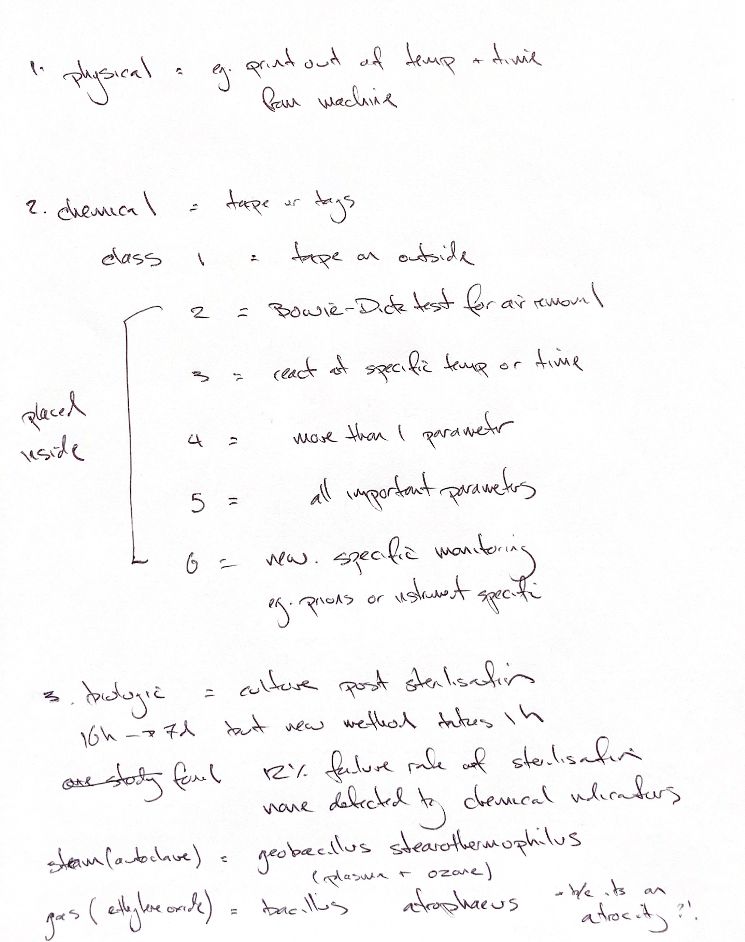
Sterilisation monitoring asks three different questions. Physical records show what the machine did. Chemical indicators show exposure to selected conditions. Biological indicators challenge the process with resistant spores.
A machine printout or graph records time and temperature. Type 1 tape outside a pack shows that it entered a process. Put a suitable internal indicator at the deepest part of the pack. A colour change alone does not prove sterility.
The six chemical types describe different jobs. Type 2 includes the Bowie–Dick air-removal test. It is run as its own test, not simply buried in a loaded instrument pack. Type 3 follows one parameter, such as time or temperature. Type 4 follows more than one. Type 5 integrates all critical process parameters. Type 6 responds to all critical parameters of a specified cycle. It does not detect prions on an instrument. The note’s prion and instrument-specific cues refer to the cycle requirements, not direct pathogen detection. The types are not a ranking from weak to strong.
In monthly testing at 11 human eye hospitals, 15/125 steam cycles failed the biological test (12%). Chemical strips changed colour in all 125 cycles, including all 15 failures. This was one surveillance study, not a failure rate for all sterilizers.
Biological indicators use Geobacillus stearothermophilus spores for steam, plasma and ozone. Ethylene oxide uses Bacillus atrophaeus. It is an aerobic spore-former, which answers the note’s anaerobe query.
Conventional culture readouts can take 16 h–7 d in the textbook examples. The studied rapid indicator gave a fluorescent readout at 1 h for 132°C and 135°C vacuum-assisted steam cycles. That hour is the readout time, not the steam exposure. Follow the specific indicator and cycle instructions.
References
Renberg & Claeys, “Sterilization,” Johnston & Tobias, Veterinary Surgery: Small Animal, 2nd ed., PDF pp. 487–489, Table 11.2. Kelkar et al., Am J Infect Control 2004;32:512–513. Schneider, Am J Infect Control 2014;42:e17–e21. CDC, Sterilizing Practices. ATCC 9372. STERIS, 6 ISO Types of Chemical Indicators.