
Sterile-pack storage
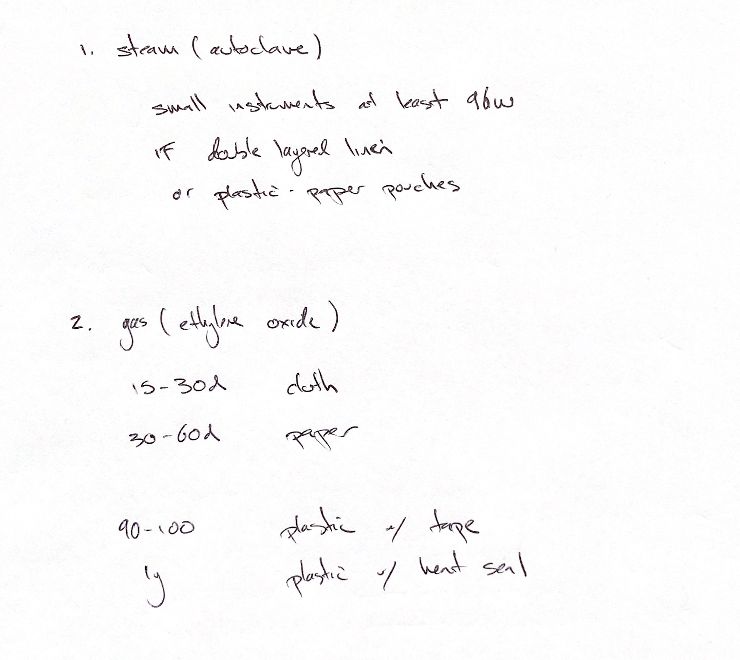
Read the draft explanation
A sterile pack depends on its barrier. Keep it sealed, undamaged and dry. A tear, puncture, failed seal or wet pack can end sterile storage before any calendar date. Store packs in a dry, clean area and handle them as little as possible. Closed cabinets reduce exposure to dust and traffic.
The 96-week study used 360 orthopaedic screws: 150 per packaged group and 60 unwrapped controls. The linen pack had a single inner layer and a double outer layer. The other pack used inner paper and a heat-sealed plastic–paper pouch. That is more specific than the note’s “double-layered linen or plastic–paper” shorthand. In clean, dry operating-room storage, neither packaged group grew organisms. At 96 weeks, 0/20 samples per packaged group grew organisms. Earlier samples were cultured along the way; this does not mean all 150 stayed unopened for 96 weeks. The finding applies to small individually packed metal items, not large sets, gauze or swabs.
The ethylene oxide list uses older time-based limits: cloth, 15–30 d; paper, 30–60 d; taped plastic, 90–100 d; and heat-sealed plastic, 1 year. Those numbers trace to a 1986 reference. They are useful historical packaging comparisons, but they do not set a universal shelf life. Current storage follows the validated packaging system, any assigned expiry, storage conditions and barrier integrity.
Inspect the package before use. If the barrier is compromised, the calendar cannot make it sterile.
References
Renberg & Claeys, “Sterilization,” Johnston & Tobias, Veterinary Surgery: Small Animal, 2nd ed., PDF p. 489. Bhumisirikul et al., Asian J Surg 2003;26:202–204. ATI, Principles and Practice of Ethylene Oxide Sterilization, 1986. CDC, Sterilizing Practices.