
Steam and dry heat
Read the draft explanation
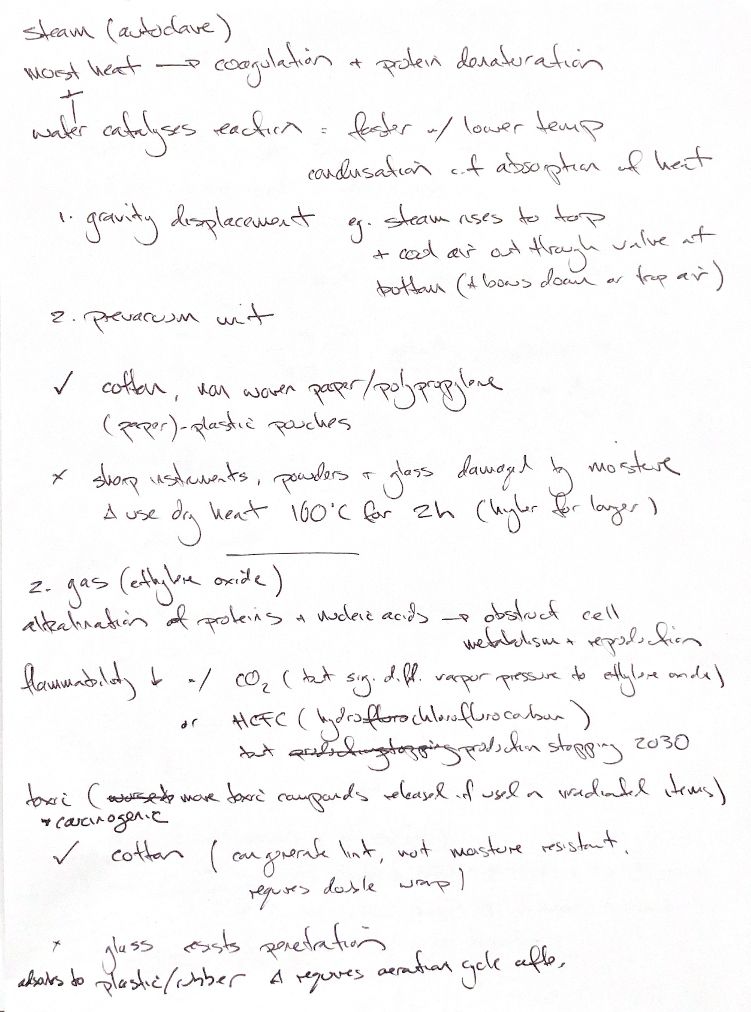
Steam kills by moist-heat coagulation and protein denaturation. Water speeds these reactions, and condensing steam transfers heat to the load. Pressure lets steam reach a higher temperature; pressure alone is not the killing step.
A gravity-displacement autoclave admits steam above the cooler air and forces that air out below. Turn bowl openings down so they do not trap air. A prevacuum unit pumps air out before steam enters. This gives steam faster, more even access to the load.
Use steam for heat- and moisture-stable loads. Compatible wraps include cotton, nonwoven paper, polypropylene and paper–plastic pouches. Certain sharp instruments, powders and glassware may need dry heat if moisture would damage them. Dry heat needs a higher temperature and longer exposure than moist heat.
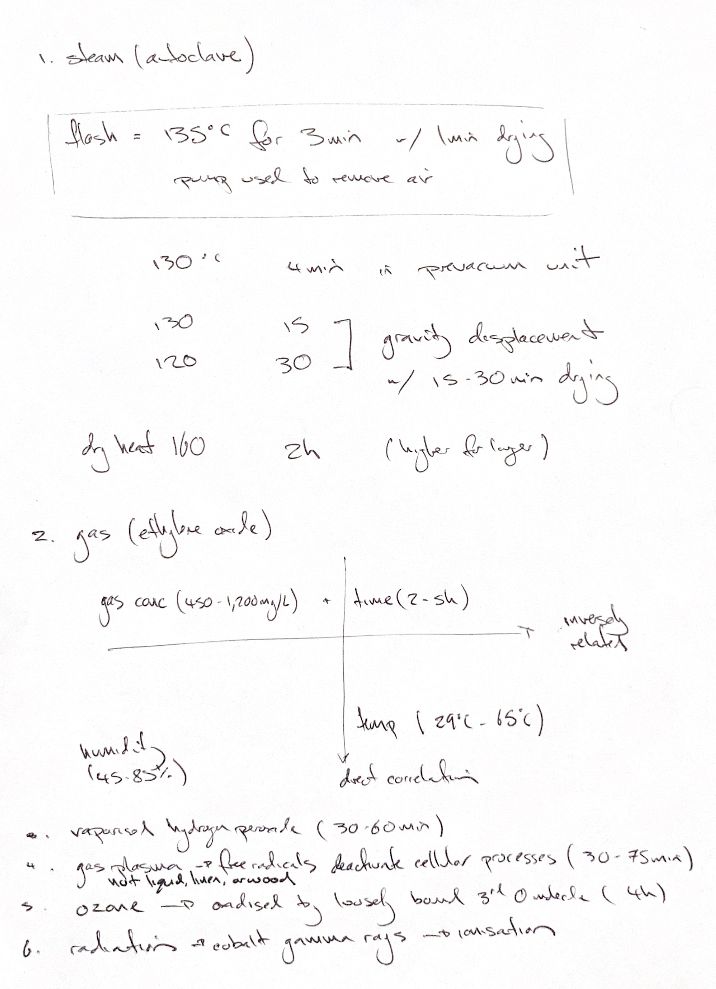
Use 121°C and 132°C for these textbook examples, rather than the rounded 120°C and 130°C in the notes: gravity displacement uses 30 min at 121°C or 15 min at 132°C, followed by 15–30 min drying. Prevacuum uses 4 min at 132°C. Dry heat can use 160°C for 120 min. Larger or complex loads may need longer validated cycles.
“Flash” is now called immediate-use steam sterilisation, or IUSS. The historical 135°C for 3 min plus 1 min drying example applies to unwrapped, nonporous metal without lumens in a gravity-displacement unit. Air pumps belong to the prevacuum mechanism, not that example. Current IUSS depends on the device, load and sterilizer instructions, including any required container and aseptic transfer. Keep it for emergencies, not convenience or routine implant processing. Short cycles still need full cleaning and safe transfer.
References
Renberg & Claeys, “Sterilization,” Johnston & Tobias, Veterinary Surgery: Small Animal, 2nd ed., PDF pp. 480, 482–484. CDC, Steam Sterilization; Flash Sterilization; Other Sterilization Methods (2008 guideline, 2023 web updates).