
Masks shoe covers and gown barriers
Read the draft explanation
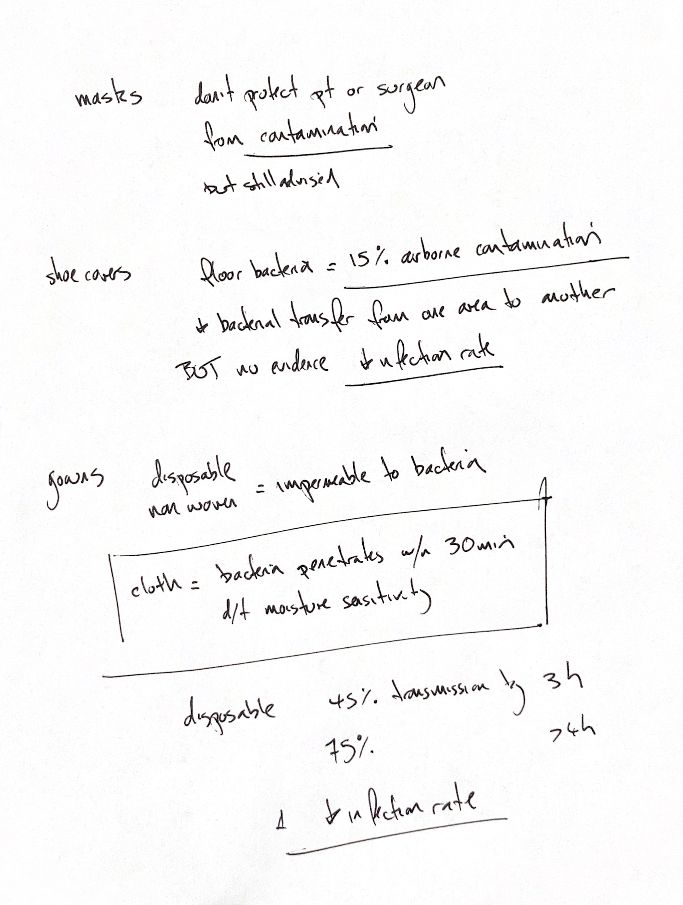
Keep surgical masks on. Human trials in clean surgery have not shown a clear fall in wound infection with masks, but this does not prove that masks offer no protection to patients or staff.
Shoe covers can reduce bacterial transfer between areas. A 1978 human operating-suite study estimated that floor redispersal supplied less than 15% of airborne bacteria. This is the share of bacteria in the air, not the share of floor bacteria that became airborne. Lower transfer has not been shown to lower surgical-site infection rates.
Gown performance depends on the material and how it handles moisture. Older woven cloth lets bacteria pass, and moisture can aid penetration. Nonwoven disposable material performed better in historical barrier tests. The often quoted 30-minute result came from a drape experiment: bacteria crossed every tested woven reusable fabric within 30 minutes, while the tested nonwoven drapes remained impermeable. It was not a timed test of every type of gown.
Older human gown data report 46.6% bacterial transmission at 3–3.5 hours and 76.5% after 4 hours. These are penetration findings, not infection rates or failure rates for all modern disposable gowns. Barrier performance alone does not prove fewer infections. WHO allows either sterile disposable nonwoven or sterile reusable woven gowns and drapes for SSI prevention.
References
Johnston & Tobias, Veterinary Surgery: Small Animal, 2nd ed., operating-room apparel; Vincent & Edwards 2016, doi:10.1002/14651858.CD002929.pub3; Hambraeus et al. 1978, doi:10.1017/S0022172400053511; Santos et al. 2005, doi:10.1590/S0104-11692005000100014; Blom et al. 2000, PMID:11103158; Moylan et al. 1975, PMID:1198308; WHO Global Guidelines for SSI Prevention, 2018.