
Glove perforation and assisted gloving
Read the draft explanation
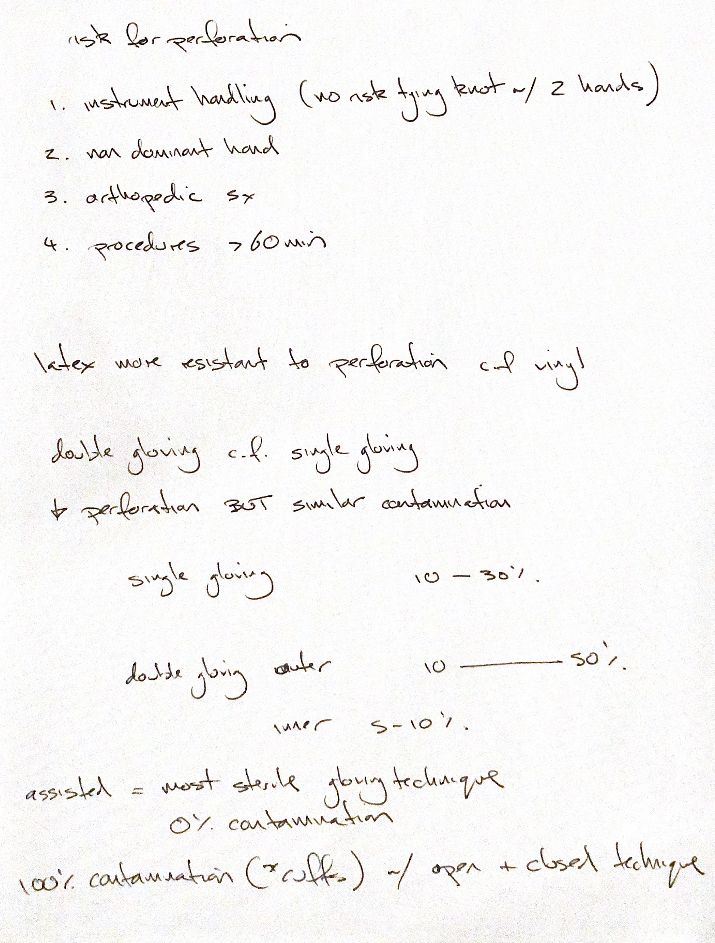
Glove defects often follow instrument handling. They occur more often on the nondominant hand, in orthopaedic or other non-soft-tissue procedures, and after 60 minutes. Latex resists perforation better than vinyl in older comparisons. Two-hand knot tying with polyester caused no detected perforations in one experiment; that finding does not make all knot tying risk-free.
A second glove adds another barrier. Historical reports give perforation ranges of 12.7–31% with single gloves, 11.5–44% for the outer glove and 3.8–13% for the inner glove. These human and veterinary studies used different settings and counting units. The ranges are not one direct comparison. Double gloving protects the inner layer, but similar contamination has been reported despite fewer holes. Perforation, contamination and wound infection are different outcomes.
Assisted gloving reduces contact between the prepared hand and the gown. In one human simulation, a single surgeon repeated each technique 20 times. UV-lotion tracer reached the gown in 20/20 open and 20/20 closed trials, mainly at the cuff. Patches appeared in 0/20 assisted trials. That is a tracer result, not a zero infection rate.
References
Johnston & Tobias, Veterinary Surgery: Small Animal, 2nd ed., operating-room apparel; Character et al. 2003, doi:10.5326/0390311; Giordano et al. 2014, doi:10.1186/1754-9493-8-26; Dodds et al. 1990, doi:10.1002/bjs.1800770228; Newman et al. 2007, Acta Orthop Belg 73:765–771.