
Patient and room preparation
Read the draft explanation
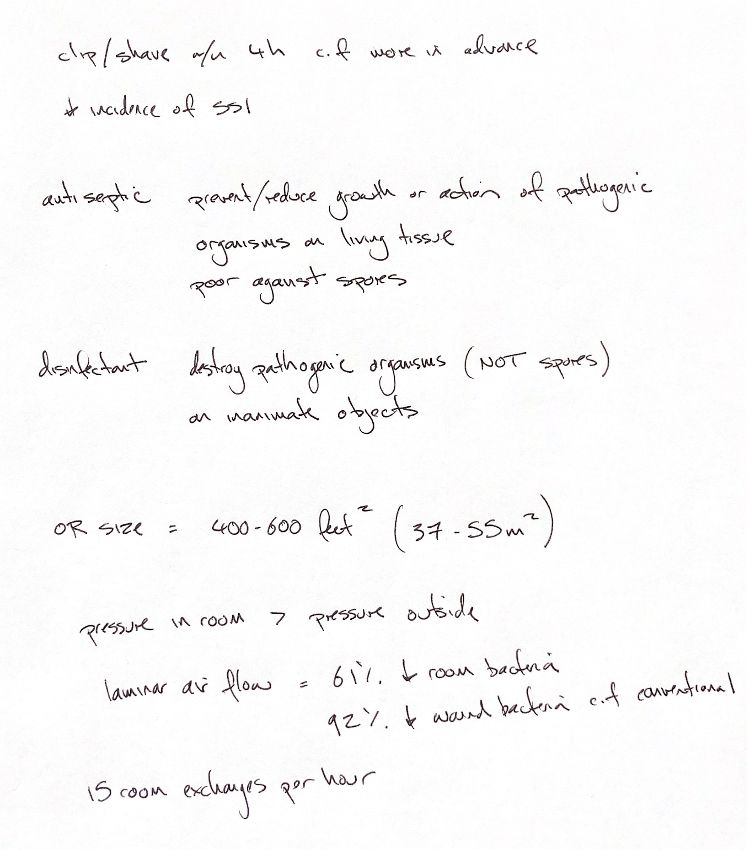
Clip close to surgery and protect the skin barrier. Clipping causes less trauma than shaving. Abrasions let organisms enter, while early clipping leaves more time for environmental recontamination.
The veterinary text uses within 4 h as a perioperative window. Brown and colleagues followed 1,574 wounds in 1,255 dogs and cats. Sites clipped before induction were three times more likely to become infected than sites clipped after induction. This was an observational comparison. It supports clipping immediately before surgery; it does not establish a precise 4 h safety cutoff.
A standard operating room has positive pressure relative to the corridor. “Negative pressure” reverses the intended relationship. Higher room pressure drives air out and limits entry of corridor air. Keep doors closed and traffic low.
The room-size examples come from human hospital guidance: about 400 ft² for a primary room and 600 ft² for complex work with larger equipment. That is about 37–56 m²; 600 ft² equals 55.7 m². Space must let the team and equipment move without crowding the sterile field.
Filtered laminar flow carries air in one direction and removes airborne particles. Older human operating-room data cited in the text describe 61% lower room bacterial counts and 92% lower counts at the wound than conventional ventilation. These are bacterial-count findings, not equivalent reductions in surgical-site infection.
The conventional human-OR ventilation example uses at least 15 total air changes per hour, including at least three outdoor-air changes. These figures describe that hospital-design context, rather than one specification for every veterinary facility.
References
Johnston & Tobias, Veterinary Surgery: Small Animal, 2nd ed., ch. 13. Brown et al., JAVMA 1997;210:1302–1306. Ritter, Clin Orthop Relat Res 1999;369:103–109. CDC Environmental Infection Control, operating-room air guidance.