
Hand preparation: organisms, skin effects and workflow
Read the draft explanation
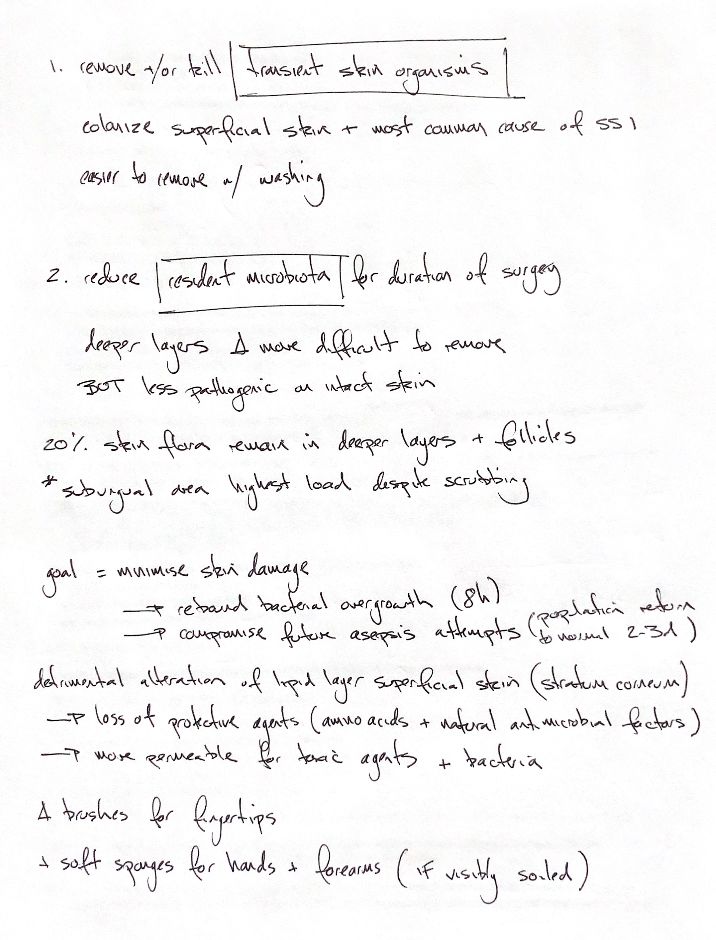
Hand prep removes transient organisms and suppresses resident flora while we operate. It does not sterilise skin. Deeper layers, follicles and the subungual area keep a reservoir.
Repeated washing strips the lipid layer and its protective factors. Abrasion adds small cracks. The stratum corneum then lets irritants and bacteria pass more easily. This favours colonisation and makes the next prep harder.
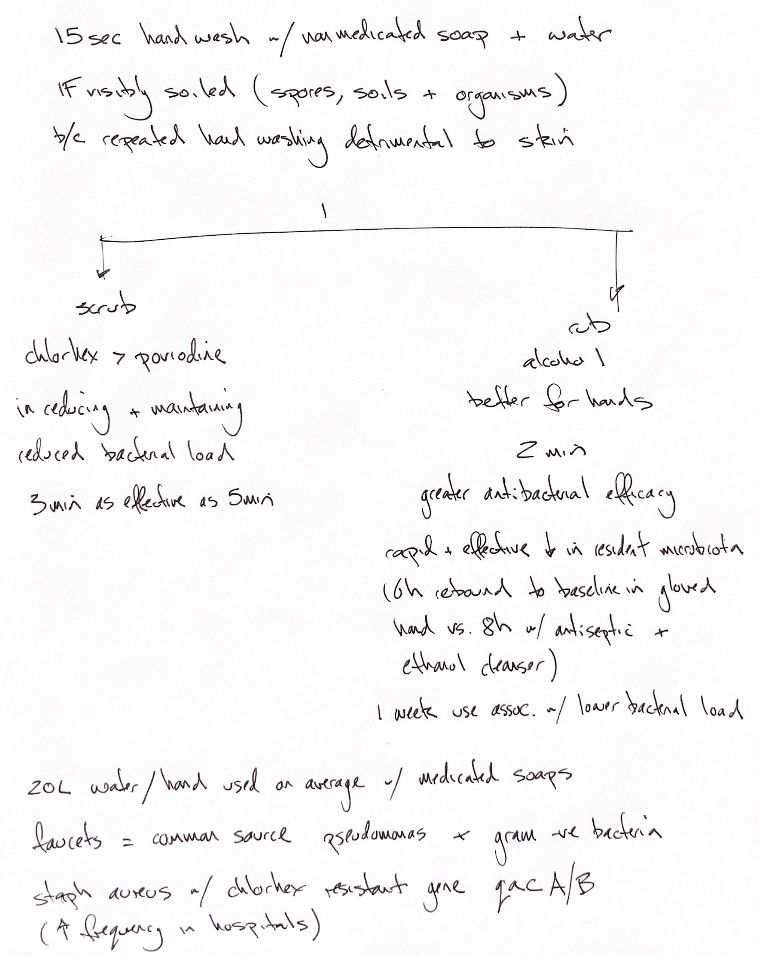
Wash visible soil off with neutral soap and water, then dry well. A brief initial wash takes about 15 s in this workflow. The antiseptic still needs its full validated contact time. A prewash also helps after patient handling, when spore contamination is likely. Choose either a validated surgical scrub or rub. Follow its label and dry fully before gloving.
Chlorhexidine generally suppresses counts better than povidone-iodine. In human product tests, 3 min matched 5 min only for certain formulations. Alcohol rub times average about 2 min (90–180 s), with less dryness, erythema and roughness than conventional scrubbing. One veterinary trial found similar immediate suppression to chlorhexidine but better sustained activity with an alcohol rub. Lower CFU counts alone do not establish lower infection rates.
Regrowth depends on the formulation and setting. The >6 h and 8 h examples come from separate reports; they do not set a safe surgical duration. A fixed 20% residual fraction and a universal 2–3 h rebound are not established hand-prep constants.
Brushes can damage skin. WHO recommends gentle nail cleaning and advises against routine brushes, including fingertip brushing. The ~20 L water estimate applies to one person for one preparation, rather than to each hand. Hospital S. aureus may carry qacA/B. This can accompany reduced antiseptic susceptibility, but does not alone prove clinical chlorhexidine failure or a rising hospital prevalence.
References
Johnston & Tobias, Veterinary Surgery: Small Animal, 2nd ed., ch. 13. Hingst et al., 1992; Pereira et al., 1997; Verwilghen et al., 2011; Temiz et al., 2014. WHO Guidelines on Hand Hygiene in Health Care, 2009.