
Perioperative antimicrobial selection and timing
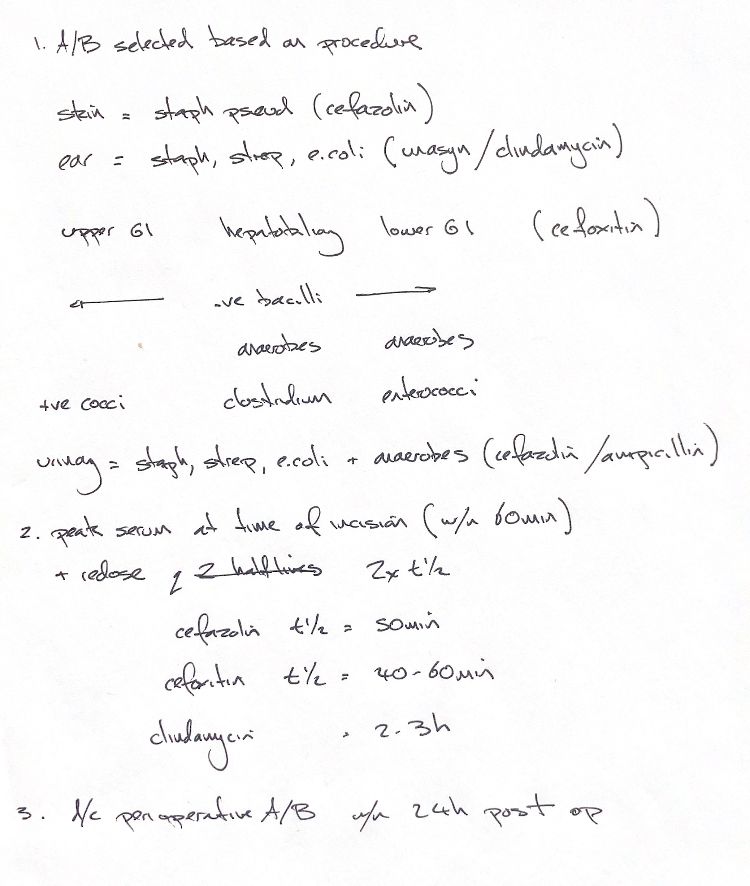
Read the draft explanation
First decide whether prophylaxis is needed. If it is, choose for likely organisms at the surgical site and local susceptibility.
Skin prophylaxis targets susceptible staphylococci. Cefazolin does not cover methicillin-resistant S. pseudintermedius (MRSP) or Pseudomonas. Ear infections can involve staphylococci, streptococci or E. coli. Ampicillin–sulbactam (Unasyn) and clindamycin are not interchangeable: clindamycin does not cover E. coli. Culture guides treatment of established infection.
Gram-negative bacilli span the GI map. Upper GI flora include Gram-positive cocci. Hepatobiliary flora include anaerobes and Clostridium; lower GI flora include anaerobes and enterococci. The 2018 cefazolin/cefoxitin examples explain site selection. Cefoxitin does not cover enterococci. Urogenital flora include staphylococci, streptococci, E. coli and anaerobes. Cefazolin or ampicillin still needs a match to the required spectrum and susceptibility.
Aim for therapeutic levels at first incision and through surgery. ENOVAT 2025 advises IV administration 30–60 min before incision when prophylaxis is indicated. For time-dependent β-lactams, consider redosing every two half-lives. Canine textbook values are cefazolin 47 min (about 50), cefoxitin 40–60 min and clindamycin 124–195 min. Clindamycin's roughly 2–3.25 h range comes from different IV studies/formulations. A half-life is not a dosing interval.
“Within 24 h” is an older stopping limit, not a required course. ENOVAT 2025 advises stopping at closure unless the procedure is contaminated. Tailor care for contamination. Established infection needs a therapeutic plan.
References
Johnston & Tobias, Veterinary Surgery: Small Animal, 2nd ed., ch. 10, Tables 10.4–10.5; ENOVAT 2025, doi:10.1111/jsap.70072; Marcellin-Little et al. 1996; Budsberg et al. 1992; Lavy et al. 1999; DailyMed cefazolin/cefoxitin labels; Pfizer Dalacin C PI.